Overview
Kabwoya Wildlife Reserve – Travel Overview
Kabwoya Wildlife Reserve is one of Uganda’s lesser-known safari destinations, offering travelers a peaceful and off-the-beaten-path wildlife experience in western Uganda. Located along the eastern shores of Lake Albert, the reserve combines open savannah, woodland, rolling hills and spectacular views across the Albertine Rift landscape.
Unlike Uganda’s more famous national parks, Kabwoya receives relatively few visitors. This makes it an appealing destination for travelers who want to experience wildlife away from busy safari routes and enjoy a more private and relaxed atmosphere.
The reserve is particularly interesting because of its location between Hoima and the Lake Albert region, making it possible to incorporate into a broader western Uganda itinerary. Visitors can combine wildlife viewing with fishing, nature walks, bird watching and scenic experiences around Lake Albert.
Kabwoya is therefore not necessarily about ticking off every major African animal. Instead, its appeal lies in the combination of wildlife, scenery, tranquility and authentic wilderness.
where is Kabwoya Wildlife Reserve?
Kabwoya Wildlife Reserve is located in western Uganda, along the eastern escarpment of the Albertine Rift and overlooking Lake Albert.
The reserve is situated within the Bunyoro region, approximately between Hoima and Lake Albert. Its position makes it accessible from western Uganda while also providing a gateway toward the Lake Albert shoreline.
The reserve covers approximately 87 square miles, making it considerably smaller than some of Uganda’s major national parks.
Its location along the Albertine Rift gives Kabwoya a particularly scenic character. Visitors can experience rolling savannah landscapes while also looking toward Lake Albert and the mountains and escarpments beyond.
This combination of wildlife and scenery is one of the reserve’s strongest attractions.
what makes Kabwoya Wildlife Reserve special?
Kabwoya is special because of its peaceful and relatively untouched atmosphere.
While destinations such as Murchison Falls, Queen Elizabeth and Kidepo are more established on the international safari circuit, Kabwoya offers something different.
There are fewer tourists, fewer safari vehicles and less commercial development.
This can make a game drive feel more exploratory.
Instead of moving between crowded wildlife sightings, travelers can spend time observing the landscape, tracking animals and enjoying the quietness of the reserve.
The views toward Lake Albert add another dimension to the experience.
For travelers who value privacy, scenery and less crowded wildlife encounters, Kabwoya can be a rewarding addition to a Uganda safari.
wildlife in Kabwoya Wildlife Reserve
Kabwoya supports a variety of wildlife adapted to its savannah and woodland habitats.
Animals commonly associated with the reserve include:
- Uganda kob
- Buffalo
- Warthog
- Waterbuck
- Bushbuck
- Oribi
- Duiker
- Hippopotamus
- Leopard
- Hyena
- Various monkeys and smaller mammals
The reserve is particularly known for its Uganda kob population, while other antelopes can be encountered across the grasslands and woodland.
Wildlife sightings naturally vary according to season, habitat and the time of day, so Kabwoya should be approached as a genuine wildlife experience rather than a destination where particular animals are guaranteed.
Uganda kob in Kabwoya
The Uganda kob is one of the most recognizable antelopes visitors can encounter in Kabwoya.
These reddish-brown antelopes are well adapted to open grassland and are often found grazing in areas where visibility is good.
Their presence makes Kabwoya interesting for travelers who enjoy observing antelope behavior rather than focusing exclusively on large predators.
Watching kob moving across the savannah, particularly during the cooler hours of the morning or late afternoon, can provide some excellent wildlife-viewing moments.
buffaloes and other large mammals
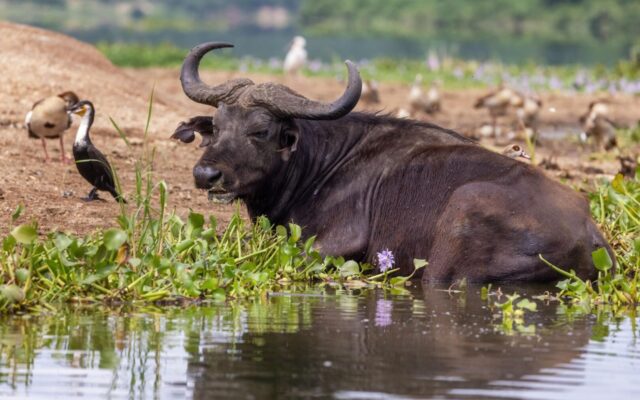
African buffaloes are also associated with Kabwoya’s wildlife.
Buffaloes are among the continent’s most impressive large herbivores and play an important role in savannah ecosystems.
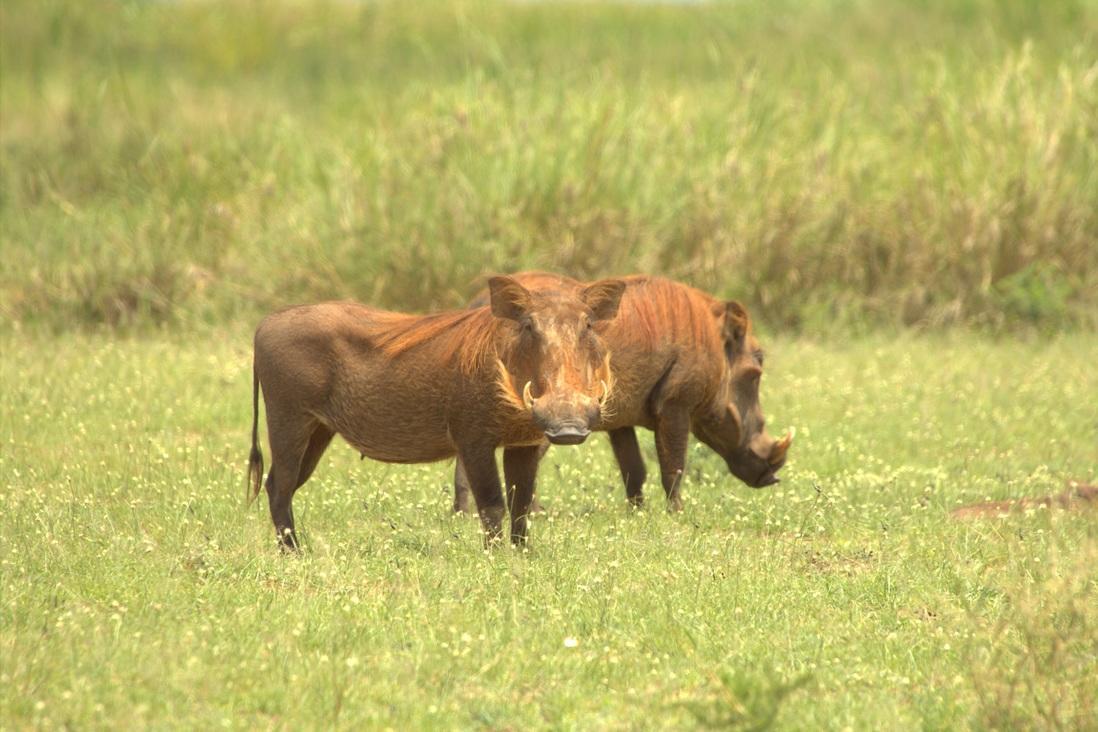
Other larger mammals include waterbuck and hippopotamus, while warthogs can often be spotted moving across open areas.
The reserve’s mixture of grassland, woodland and water-associated habitats allows different species to occupy different parts of the ecosystem.
predators in Kabwoya
Kabwoya also supports predators, including leopards and hyenas.
Leopards are naturally elusive and are often most active when temperatures are cooler. Their secretive nature means sightings are never guaranteed.
Hyenas are more adaptable and can travel across considerable distances in search of food.
For travelers interested in predators, early morning and late afternoon game drives offer the best opportunity to search for wildlife when activity is generally higher.
Lake Albert and Kabwoya
One of Kabwoya’s biggest advantages is its proximity to Lake Albert.
The lake forms an important part of the landscape and provides a dramatic backdrop to the reserve.
Lake Albert is one of the Great Lakes of Africa and lies along the border between Uganda and the Democratic Republic of the Congo.
Its presence creates an opportunity to combine a traditional savannah wildlife experience with activities associated with the lake.
Depending on the itinerary, visitors can enjoy:
- Scenic lake views
- Fishing experiences
- Bird watching
- Nature walks
- Sunset experiences
- Local community encounters
The lake therefore adds variety to a Kabwoya safari.
fishing around Kabwoya
Fishing is one of the experiences that can complement a visit to Kabwoya.
Lake Albert is well known for its fisheries and supports communities whose livelihoods are connected to the lake.
For travelers interested in combining wildlife and fishing, Kabwoya can provide an interesting alternative to a conventional game-drive-only safari.
Fishing activities should be arranged through authorized local operators and communities, particularly where regulations or seasonal restrictions apply.
bird watching in Kabwoya
Kabwoya’s combination of savannah, woodland, wetlands and Lake Albert creates a variety of habitats for birdlife.
Birders can look for species associated with:
- Open grassland
- Woodland
- Wetlands
- Lake shores
- Riverine environments
The Albertine Rift is also one of Africa’s important biodiversity regions, making the wider area particularly interesting for bird enthusiasts.
A visit to Kabwoya can therefore be combined with birding rather than treating wildlife viewing as the only activity.
For serious birders, a local guide familiar with the reserve can significantly improve the experience.
nature walks in Kabwoya
Nature walks provide an opportunity to experience the reserve from a completely different perspective.
Instead of simply looking for large animals from a vehicle, walking allows visitors to pay attention to smaller details such as:
- Animal tracks
- Birds
- Insects
- Trees
- Flowers
- Animal signs
- Rock formations
- Local vegetation
Walking should always be conducted with an appropriately trained guide or according to current reserve regulations.
The slower pace can be particularly enjoyable for travelers who want to understand the ecosystem rather than simply photograph large mammals.
game drives in Kabwoya
Game drives are the main way to explore Kabwoya Wildlife Reserve.
A safari vehicle allows visitors to cover more ground and search different habitats for wildlife.
Morning drives can be particularly rewarding because temperatures are cooler and many animals are active.
Afternoon drives provide another opportunity to explore before sunset.
During a game drive, you may encounter:
- Uganda kob
- Buffalo
- Waterbuck
- Warthog
- Bushbuck
- Oribi
- Monkeys
- Hippos
- Hyenas
- Leopards
The experience is less about rushing from one sighting to another and more about exploring the reserve at a relaxed pace.
sunset experiences in Kabwoya
The landscape around Kabwoya and Lake Albert is particularly attractive during the evening.
As the sun moves toward the horizon, the savannah changes color while Lake Albert provides an expansive backdrop.
A well-positioned sunset can be one of the most memorable moments of the trip.
For photographers, this period offers opportunities to capture:
- Wildlife silhouettes
- Savannah landscapes
- Lake views
- Acacia trees
- Evening light
- Local fishing communities
This is one of the areas where Kabwoya can compete strongly with more famous safari destinations: the scenery does not need a large concentration of wildlife to be impressive.
photography in Kabwoya Wildlife Reserve
Kabwoya is particularly suitable for travelers interested in wildlife and landscape photography.
The combination of animals and dramatic scenery creates opportunities for wider environmental photographs rather than only close-up animal portraits.
Photographers can capture Uganda kob or buffalo against open grasslands, birds around wetlands and landscapes overlooking Lake Albert.
Early morning and evening generally provide the most attractive natural light.
Because visitor numbers are lower than in many of Uganda’s major parks, photographers may also have more space and time to compose their images.
the Albertine Rift landscape
Kabwoya’s location within the Albertine Rift gives it considerable ecological importance.
The Albertine Rift contains some of Africa’s most biologically diverse ecosystems.
Although Kabwoya’s environment is largely savannah and woodland, its position within this larger landscape connects it to a region containing forests, lakes, mountains and other protected ecosystems.
This makes Kabwoya interesting not only as a safari destination but also from a conservation perspective.
community experiences around Kabwoya
A visit to Kabwoya can also introduce travelers to communities living around the reserve and Lake Albert.
Fishing communities along the lake provide an opportunity to learn about livelihoods connected to one of Uganda’s major inland lakes.
Community experiences should always be arranged respectfully and with local participation.
For travelers interested in responsible tourism, supporting locally run services, guides and community enterprises can help ensure that tourism contributes to people living around the reserve.
accommodation in Kabwoya Wildlife Reserve
Accommodation around Kabwoya is considerably more limited than in Uganda’s major national parks.
This is part of the destination’s appeal for travelers who prefer a quieter safari experience.
Visitors can find safari-style accommodation and camping options in and around the reserve, while additional accommodation can be found in nearby areas.
For a comfortable itinerary, it is important to confirm the availability and location of accommodation before traveling, particularly during peak periods.
Travelers who enjoy a more adventurous experience can also consider camping, subject to current regulations and arrangements.
camping in Kabwoya
Camping allows visitors to experience the reserve more closely.
A night surrounded by savannah sounds can be very different from staying in a large hotel.
The experience can include:
- Sunset over the reserve
- Evening wildlife sounds
- Clear night skies
- Early morning bird calls
- Sunrise over the savannah
Because Kabwoya is a wildlife area, camping should only be undertaken in designated or approved locations and with appropriate safety arrangements.
best time to visit Kabwoya Wildlife Reserve
Kabwoya can be visited throughout the year, but the experience varies with the seasons.
The drier months are generally favorable for wildlife viewing because vegetation is less dense and animals may concentrate around available water sources.
The wet seasons bring greener vegetation, beautiful landscapes and increased bird activity.
For photographers, the greener season can be particularly attractive because the landscape becomes more vibrant.
So rather than saying there is only one perfect time to visit, travelers can choose according to what they want from the safari.
For easier wildlife viewing: consider the drier periods.
For greener landscapes and birding: consider the wetter periods.
how to get to Kabwoya Wildlife Reserve
Kabwoya can be accessed by road from western Uganda.
Hoima is an important gateway for reaching the Lake Albert side of the region.
The journey can be incorporated into a wider western Uganda itinerary.
Depending on the starting point, travelers may approach through the Hoima area before continuing toward the reserve.
A 4×4 safari vehicle is recommended for exploring the reserve, particularly where roads become rough or during wetter conditions.
Because access roads and local conditions can change, travelers should confirm the current route before departure.
how many days do you need in Kabwoya?
For most travelers, two days is enough to experience Kabwoya at a comfortable pace.
A two-day visit can include:
Day 1: Arrival, afternoon game drive and sunset experience.
Day 2: Morning game drive, nature experience or birding, followed by departure.
Travelers who want to combine wildlife with fishing and community experiences can extend their stay.
Kabwoya also works particularly well as part of a longer western Uganda itinerary.
Kabwoya as part of a western Uganda safari
Kabwoya can be incorporated into a broader journey through western Uganda.
For example, travelers could combine it with:
Kabwoya → Hoima → Fort Portal → Kibale → Queen Elizabeth
This allows visitors to experience several completely different environments, from Lake Albert and savannah to rainforest and crater landscapes.
For travelers coming from Murchison Falls, Kabwoya can also provide an alternative route toward western Uganda.
This makes the reserve useful not only as a standalone destination but as a connecting point within a wider Uganda safari itinerary.
is Kabwoya good for first-time safari travelers?
Yes, but expectations are important.
If this is someone’s first African safari and they want the greatest possible concentration of iconic wildlife, Uganda’s major national parks may be a better starting point.
Kabwoya is more suitable for travelers who appreciate:
- Quiet wildlife experiences
- Fewer tourists
- Scenic landscapes
- Smaller safari destinations
- Birding
- Fishing
- Photography
- Off-the-beaten-path travel
For repeat visitors to Uganda, Kabwoya can be particularly appealing because it offers something different from the country’s major safari circuits.
is Kabwoya good for families?
Kabwoya can work well for families who enjoy nature and outdoor activities.
The combination of wildlife, Lake Albert, birding and scenery provides different experiences for children and adults.
However, families should consider the road journey and accommodation style when planning the trip.
A well-organized itinerary with comfortable accommodation and manageable driving times will make the experience much more enjoyable.
conservation in Kabwoya
Kabwoya plays an important role in protecting wildlife habitat along the Lake Albert and Albertine Rift landscape.
Like many protected areas, the reserve exists alongside communities whose livelihoods depend on surrounding natural resources.
Conservation therefore requires cooperation between wildlife authorities, communities, tourism operators and visitors.
Responsible tourism can contribute by creating income for local communities while encouraging the continued protection of wildlife habitats.
Visitors should follow reserve regulations, avoid disturbing wildlife and ensure that their activities have minimal environmental impact.
why visit Kabwoya Wildlife Reserve?
Kabwoya is a destination for travelers who want to slow down and experience Uganda differently.
It may not have the international fame of Murchison Falls or Queen Elizabeth, but that is precisely part of its charm.
Here, the safari experience is about more than simply counting animals.
It is about driving through quiet savannah.
Watching Uganda kob across the grasslands.
Searching the woodland for elusive predators.
Listening to birds around the wetlands.
Looking across the vast waters of Lake Albert.
Watching the sun disappear over the Albertine landscape.
And experiencing a side of Uganda that many visitors never get to see.
For travelers seeking an off-the-beaten-path Uganda safari, Kabwoya Wildlife Reserve deserves a place on the map.
frequently asked questions
what is Kabwoya Wildlife Reserve famous for?
Kabwoya is known for its quiet savannah environment, Uganda kob, diverse antelopes, birdlife, scenic views and proximity to Lake Albert.
where is Kabwoya Wildlife Reserve located?
It is located in western Uganda along the eastern side of Lake Albert, within the broader Albertine Rift landscape.
what animals can I see in Kabwoya?
Wildlife associated with the reserve includes Uganda kob, buffalo, waterbuck, warthog, bushbuck, oribi, hippos, hyenas and leopards.
can I see leopards in Kabwoya?
Leopards occur in the reserve, but sightings are naturally unpredictable because they are elusive animals.
can I go fishing near Kabwoya?
Yes. The Lake Albert area provides opportunities for fishing, subject to local regulations and arrangements.
is Kabwoya good for bird watching?
Yes. The combination of savannah, woodland, wetlands and Lake Albert provides a variety of habitats for birds.
how many days should I spend in Kabwoya?
Two days is a good starting point, while travelers interested in fishing, birding or combining several activities can stay longer.
where do I stay when visiting Kabwoya?
Accommodation is available around the reserve, including safari-style accommodation and camping options. Availability should be confirmed before travel.
when is the best time to visit Kabwoya?
The dry periods are generally favorable for easier wildlife viewing, while the wetter periods offer greener scenery and good birding opportunities.
can Kabwoya be combined with other Uganda destinations?
Yes. It can be incorporated into western Uganda itineraries involving destinations such as Kibale, Queen Elizabeth and the Lake Albert region.