



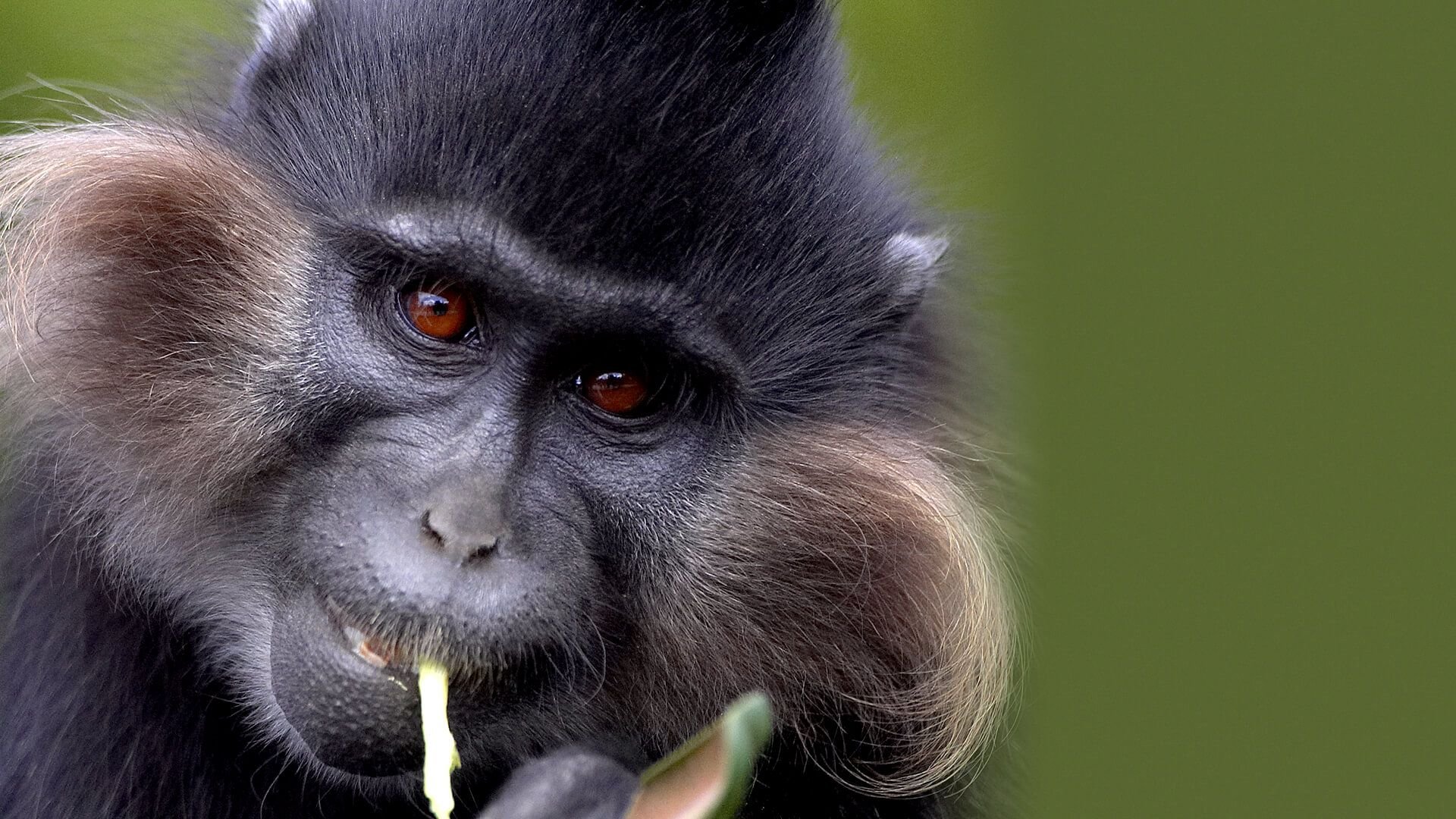
Uganda Mangabey
The Uganda mangabey (Lophocebus ugandae) is a fascinating monkey found only in Uganda. Also known as the Uganda grey-cheeked mangabey, it belongs to the mangabey group of African Old World monkeys and is closely associated with Uganda’s forest ecosystems.
For travelers interested in Uganda wildlife and primates, this is an especially interesting species because seeing one means encountering an animal that is uniquely connected to the country.
The Uganda mangabey isn’t as famous internationally as the mountain gorilla or chimpanzee, but that doesn’t make it any less fascinating. In fact, its relatively limited distribution makes a sighting particularly rewarding for wildlife enthusiasts who want to look beyond Uganda’s famous flagship species.
It is an agile forest monkey, generally living in groups and spending much of its time moving through trees in search of food.
And because it can be difficult to spot among dense vegetation, finding a troop often requires patience, a good guide and a little luck.
Quick Facts About the Uganda Mangabey
| Common name | Uganda mangabey |
|---|---|
| Also known as | Uganda grey-cheeked mangabey |
| Scientific name | Lophocebus ugandae |
| Family | Cercopithecidae |
| Animal group | Old World monkey |
| Country of significance | Uganda |
| Habitat | Forests and woodland |
| Lifestyle | Mainly arboreal |
| Diet | Fruits, leaves, seeds, flowers and other foods |
| Social structure | Social groups |
| Main threats | Habitat loss and fragmentation |
| Best known Ugandan habitat | Forest ecosystems around western and central Uganda |
What Does a Uganda Mangabey Look Like?
The Uganda mangabey has a dark brown to greyish coat with noticeably lighter coloration around the cheeks.
Its appearance is relatively subtle compared with some of Uganda’s more colorful monkeys.
However, once you know what to look for, several features can help identify it.
These include:
- Dark body
- Lighter greyish cheeks
- Long tail
- Strong limbs
- Relatively robust body
- Dark facial area
The long tail is particularly useful when watching a troop move through the canopy.
As the animals leap between branches, their tails help with balance and movement.
Why Is It Called the Uganda Mangabey?
The name reflects its geographical association.
The Uganda mangabey is a Uganda-specific species, making it particularly significant for the country’s wildlife heritage.
This is an important distinction when discussing Uganda’s primates.
Some species found in Uganda occur across several African countries.
The Uganda mangabey, however, has a much more restricted distribution.
That gives it a special place among the country’s wildlife species.
Is the Uganda Mangabey the Same as the Grey-cheeked Mangabey?
This is where things can get a little confusing.
The Uganda mangabey was historically treated as part of the broader grey-cheeked mangabey group.
Modern taxonomic treatments recognize the Uganda mangabey as a distinct species, Lophocebus ugandae, while the grey-cheeked mangabey is generally treated as Lophocebus albigena.
For your website, I’d therefore keep Uganda Mangabey and Grey-cheeked Mangabey as separate pages, while explaining their relationship.
That gives you an opportunity to capture searches for both terms without making the pages look like duplicates.
Where Does the Uganda Mangabey Live?
The Uganda mangabey is associated with forest and woodland habitats.
Its environment can include:
- Tropical forest
- Secondary forest
- Woodland
- Forest edges
- Dense vegetation
Trees are particularly important because they provide food, shelter and movement routes.
The species is primarily arboreal, although it can sometimes move closer to the ground.
Where Can You See Uganda Mangabeys?
For travelers, the most important point is that Uganda mangabeys are associated with forest areas in the country, particularly western and central Uganda.
They have been recorded in several forest habitats, including areas around the Lake Victoria basin and western Uganda.
This makes them part of the wider primate diversity that makes Uganda such an interesting wildlife destination.
Uganda Mangabey and Kibale National Park
Kibale is one of Uganda’s most important primate landscapes.
The park is famous for chimpanzees, but its forests support a remarkable variety of monkeys.
Visitors may encounter species such as:
- Red-tailed monkeys
- Blue monkeys
- L’Hoest’s monkeys
- Black-and-white colobus monkeys
- Mantled guerezas
- Grey-cheeked mangabeys and related mangabey populations
This makes Kibale an important destination for travelers who want to experience Uganda’s primate diversity rather than focusing on one species alone.
What Does the Uganda Mangabey Eat?
The Uganda mangabey has a flexible diet.
Its food can include:
- Fruits
- Leaves
- Seeds
- Flowers
- Young shoots
- Insects
- Other available foods
Fruit can be particularly valuable when available.
However, the ability to consume different foods allows the monkeys to adapt to seasonal changes.
When one food source becomes scarce, they can move to another.
Why Is Their Diet Important?
Forest food availability changes throughout the year.
One tree may produce fruit for only a few weeks.
Another may flower during a different season.
Insects may become more abundant after rainfall.
A flexible diet helps the Uganda mangabey cope with these changes.
It also encourages the monkeys to move through different parts of the forest while searching for food.
How Do Uganda Mangabeys Move?
They are highly adapted to life in trees.
Their strong limbs and long tail allow them to:
- Climb
- Leap
- Balance on branches
- Move through dense vegetation
- Travel between trees
A troop can move surprisingly quickly when it is traveling between feeding areas.
Young monkeys are particularly active and can often be seen playing and climbing around the adults.
Do Uganda Mangabeys Live in Trees?
Yes.
Although they can move on the ground, trees are central to their lifestyle.
The canopy provides:
- Food
- Shelter
- Sleeping sites
- Escape routes
- Protection
For an arboreal species, a healthy forest is essentially both a home and a transportation network.
This is why forest fragmentation can have serious consequences.
Uganda Mangabey Social Behavior
Uganda mangabeys are social monkeys.
They generally live in groups and spend considerable time interacting with one another.
Group living provides several advantages.
Members can cooperate in:
- Predator detection
- Infant protection
- Food searching
- Communication
- Social bonding
A troop may contain individuals of different ages.
Young animals learn many important survival skills by observing adults and interacting with other juveniles.
How Do Uganda Mangabeys Communicate?
Communication is an important part of mangabey life.
They use vocalizations to maintain contact between individuals and respond to potential threats.
In dense forest, visual contact isn’t always possible.
A monkey may disappear behind leaves or move to another section of the canopy.
Vocal communication allows the troop to remain socially connected.
You may actually hear a mangabey before you see it.
What Do Their Calls Mean?
Different calls can serve different purposes.
They may communicate:
- Alarm
- Group movement
- Contact
- Social interactions
- Territorial information
For wildlife guides, learning the calls of forest monkeys can be extremely useful.
A guide may hear a particular sound and know that a troop is nearby even before tourists notice movement in the trees.
Uganda Mangabey Mothers and Infants
Female Uganda mangabeys provide extensive care to their young.
Infants remain close to their mothers during their early development.
The mother provides:
- Protection
- Carrying
- Warmth
- Feeding support
- Social learning
As the youngster grows, it begins exploring more of the environment.
It learns to climb, leap, find food and interact with other members of the group.
Young Mangabeys and Play
Young monkeys spend considerable time playing.
They may:
- Chase each other
- Climb
- Jump
- Wrestle
- Explore branches
These activities are important for developing strength and coordination.
They also teach young animals how to behave socially.
A playful interaction may therefore be preparation for many of the skills they will need as adults.
What Predators Hunt Uganda Mangabeys?
Forest monkeys face several natural predators.
Potential predators include:
- Leopards
- Large snakes
- Birds of prey
- Other forest predators
Young animals are particularly vulnerable.
The group’s social structure helps reduce the risk because multiple individuals can watch for danger.
How Do Uganda Mangabeys Escape Predators?
Their greatest advantage is the forest itself.
If a predator approaches, they can move rapidly into the canopy.
They can climb higher, leap between branches and disappear into dense vegetation.
Alarm calls can also warn other group members.
A troop can therefore combine speed, agility, camouflage and group vigilance to reduce the risk of predation.
Uganda Mangabey and Forest Ecology
The Uganda mangabey is an important part of its ecosystem.
By consuming fruits, the monkeys can contribute to seed dispersal.
They also influence vegetation through their feeding behavior.
At the same time, they form part of the food chain for larger predators.
Their presence therefore reflects the health and complexity of the forest ecosystem.
Why Forest Conservation Matters
The Uganda mangabey depends on suitable forest habitat.
When forests are cleared or fragmented, several problems can occur.
The monkeys may lose:
- Feeding areas
- Sleeping trees
- Movement routes
- Breeding habitat
- Protection from predators
This is why protecting remaining forests is essential.
Maintaining connections between forest patches can be particularly important for arboreal primates.
Uganda Mangabey vs Grey-cheeked Mangabey
This is an important comparison for your website.
The two are closely related and have historically been grouped together taxonomically.
However, the Uganda mangabey (Lophocebus ugandae) is recognized as a distinct species, while the grey-cheeked mangabey (Lophocebus albigena) is a separate species.
Both are forest monkeys with similar general body shapes and diets.
The biggest distinction for a tourist is geographical:
Uganda mangabey → Uganda-specific species
Grey-cheeked mangabey → broader Central/East African distribution
This makes the Uganda mangabey particularly interesting for wildlife enthusiasts searching for species unique to Uganda.
Uganda Mangabey vs Red-Tailed Monkey
Red-tailed monkeys are smaller and have distinctive reddish coloration around the tail.
Uganda mangabeys are generally more robust and have noticeably lighter cheeks.
Both are forest primates and can occupy overlapping environments.
Uganda Mangabey vs Blue Monkey
Blue monkeys have a more greyish body and different facial characteristics.
Uganda mangabeys are generally darker and have more pronounced cheek coloration.
Both species are agile forest monkeys with flexible diets.
Uganda Mangabey vs L’Hoest’s Monkey
L’Hoest’s monkeys are recognizable by their darker body and pale throat area.
Uganda mangabeys have lighter cheek coloration and a different facial appearance.
Both are forest specialists and are valuable components of Uganda’s primate diversity.
Uganda Mangabey vs Mantled Guereza
The difference is much easier to see.
Mantled guerezas are striking black-and-white monkeys with long flowing white hair.
Uganda mangabeys are darker and more uniformly colored.
Guerezas are especially specialized for eating leaves, while mangabeys have a broader diet.
Uganda Mangabey vs Black-and-White Colobus
Both can be found in Uganda’s forests.
The black-and-white colobus has a dramatic black-and-white coat and reduced thumb, adaptations associated with its highly arboreal lifestyle.
The Uganda mangabey has a darker, more uniform appearance and a more flexible diet.
Can You See Uganda Mangabeys on Safari?
Yes, but this is not necessarily a species that visitors should expect to encounter as easily as baboons or vervet monkeys.
They are forest animals.
They can remain high in the canopy.
And dense vegetation can make them difficult to observe.
A knowledgeable guide is therefore extremely valuable.
If you’re interested in seeing Uganda’s less-famous primates, a primate-focused forest experience can be much more rewarding than simply passing through the forest on a general wildlife drive.
What Is It Like to See a Uganda Mangabey?
Imagine walking through an ancient Ugandan forest.
You hear movement overhead.
Your guide stops.
A dark monkey suddenly leaps across a branch.
Another follows.
Then you notice the lighter cheeks.
The troop continues moving through the canopy, calling to one another.
For most visitors, it won’t be the dramatic encounter of standing meters away from a mountain gorilla.
Instead, it’s a glimpse into the secret world of Uganda’s forest canopy.
And that’s exactly what makes it special.
Best Time to See Uganda Mangabeys
They can potentially be encountered throughout the year in suitable habitats.
Sightings depend on:
- Weather
- Food availability
- Vegetation
- Animal movements
- Forest conditions
- Guide expertise
There is no guaranteed month for finding them.
If you’re planning a primate safari, it’s better to choose your travel period around your major experiences and treat the Uganda mangabey as one of the rewarding species you may encounter.
How Difficult Are They to Spot?
They can be challenging.
Their dark coloration can disappear into the forest canopy.
They can also move rapidly through branches.
Dense foliage may hide an entire troop.
However, their vocalizations can sometimes reveal their location.
This is where an experienced guide can make a major difference.
Photography Tips
Photographing Uganda mangabeys can be challenging because of their movement and the forest lighting.
Try capturing:
- Face and cheek markings
- Full-body portraits
- Leaping
- Feeding
- Grooming
- Mother and infant interactions
- Juvenile play
- Wide environmental shots
Don’t become frustrated if the first photographs aren’t perfect.
Sometimes the best image is simply the one that captures the monkey naturally moving through its forest environment.
Conservation Challenges
The Uganda mangabey’s biggest challenges are connected to habitat.
Forest loss
Clearing forests for agriculture and development reduces available habitat.
Fragmentation
Breaking forests into isolated patches can restrict movement.
Hunting
Some forest primates are hunted for meat in parts of their range.
Human pressure
Increasing activity around forest boundaries can disturb wildlife.
Protecting forest ecosystems is therefore essential for the species’ future.
Responsible Wildlife Viewing
If you encounter a Uganda mangabey:
- Keep your distance.
- Don’t feed it.
- Don’t chase it.
- Don’t make loud noises.
- Don’t throw objects to attract its attention.
- Don’t attempt to touch it.
- Follow your guide’s instructions.
The best wildlife encounter is one where the animal continues behaving naturally.
Interesting Facts About the Uganda Mangabey
It is a Uganda-specific primate.
This makes it particularly valuable to the country’s wildlife heritage.
It belongs to the mangabey group.
It is an Old World monkey in the genus Lophocebus.
It is mainly arboreal.
Trees provide food, shelter and movement routes.
It is social.
Individuals live and interact within groups.
It has distinctive greyish cheeks.
This feature helps distinguish it from several other Ugandan monkeys.
It has a long tail.
The tail helps with balance while moving through the canopy.
It has a flexible diet.
Fruits, leaves, seeds, flowers and animal foods can all form part of its diet.
It is difficult to spot.
Dense vegetation and canopy movement can make sightings challenging.
It is important to Uganda’s forest ecosystems.
Protecting its habitat also protects many other species.
Frequently Asked Questions
What is the Uganda mangabey?
The Uganda mangabey (Lophocebus ugandae) is a forest-dwelling Old World monkey recognized as a distinct species and associated specifically with Uganda.
Is the Uganda mangabey the same as the grey-cheeked mangabey?
No. They are closely related and were historically grouped together, but they are now recognized as separate species.
Where can I see Uganda mangabeys?
They occur in suitable forest habitats in Uganda, including forests within the country’s central and western regions.
What does a Uganda mangabey eat?
Its diet includes fruits, leaves, seeds, flowers, young shoots and various animal foods.
Is the Uganda mangabey endangered?
The species faces habitat-related pressures, particularly forest loss and fragmentation. Conservation of Uganda’s remaining forests is important for its long-term survival.
Are Uganda mangabeys aggressive?
They are wild animals and should never be approached or handled. They generally avoid people when given sufficient space.
Can Uganda mangabeys climb?
Yes. They are highly adapted to moving through trees and can climb and leap efficiently through the canopy.
Can I see Uganda mangabeys during a primate safari?
Yes, potentially. Uganda’s forests support several primate species, although sightings are not guaranteed.
Why the Uganda Mangabey Matters
The Uganda mangabey is exactly the kind of species that deserves a place on a comprehensive Uganda wildlife website.
Most tourists know Uganda for gorillas.
Many know about chimpanzees.
Some know about lions, elephants and giraffes.
But species like the Uganda mangabey tell a deeper story.
They demonstrate that Uganda’s wildlife isn’t limited to the animals appearing on the front covers of safari brochures.
Its forests contain a remarkable collection of lesser-known primates, each with its own adaptations, behavior and ecological role.
And because the Uganda mangabey is so closely associated with Uganda itself, it gives travelers another reason to appreciate the country’s unique biodiversity.
For someone building a Uganda wildlife species resource, this is exactly the kind of species page that helps turn the website into a genuinely useful reference for travelers.