






Overview
Amabere Caves & Fort Portal Crater Lakes – Travel Overview
Amabere Caves and the Fort Portal Crater Lakes are among the most scenic and culturally interesting attractions in western Uganda. Located around Fort Portal, the experience combines limestone caves, waterfalls, traditional Tooro legends, volcanic crater lakes, rolling green hills, tea plantations and spectacular countryside.
The area is particularly appealing to travelers who want something different from Uganda’s traditional wildlife safaris.
Instead of spending the day searching for animals, visitors can explore caves, walk through the countryside, visit crater lakes, enjoy panoramic views and learn about the cultural traditions of the Tooro Kingdom.
Fort Portal itself serves as an excellent base for exploring this region and is officially promoted as Uganda’s Tourism City.
The destination is also strategically positioned close to Kibale National Park, Semuliki National Park and the Rwenzori Mountains, making it easy to incorporate into a western Uganda itinerary.
Where Are Amabere Caves and the Crater Lakes?
The attractions are found around Fort Portal in western Uganda, within the scenic landscape of the Tooro region.
The Amabere Caves, also known as Amabere Ga Nyinamwiru, are located in the Nyakasura area, only several kilometres from Fort Portal. Sources place the caves at roughly 7–9 kilometres from the city, depending on the reference point used.
The surrounding countryside contains dozens of crater lakes, with Fort Portal serving as the main urban base for exploring them.
Fort Portal City describes the surrounding region as having more than 50 crater lakes, while other tourism sources count the wider crater field differently depending on which lakes are included.
Amabere Caves
The Amabere Ga Nyinamwiru Caves are limestone formations associated with one of the best-known legends of the Tooro region.
The cave environment contains stalactites and stalagmites, while water flows through the surrounding landscape and contributes to the area’s lush appearance.
The site is also associated with waterfalls and views toward nearby crater lakes, making it more than simply a cave visit.
The Legend of Nyinamwiru
The name Amabere Ga Nyinamwiru is commonly translated as “the breasts of Nyinamwiru.”
According to the local legend, Nyinamwiru was the daughter of King Bukuku.
The story tells of conflict surrounding her father’s wishes for her marriage and the punishment that followed.
The unusual limestone formations inside the caves became associated with Nyinamwiru and are traditionally interpreted as her breasts.
The story is part of the cultural heritage surrounding the site rather than a scientific explanation for the formation of the rocks.
This combination of geology and oral tradition is what makes Amabere particularly interesting.
The Geology of Amabere Caves
Behind the legend is a genuine geological environment.
The caves are formed in limestone, with stalactites and stalagmites created through the deposition of calcium carbonate over long periods.
Water moving through the rock has contributed to the formation of the cave features.
The Uganda National Environment Management Authority’s heritage information also identifies the Nyakasura caves as limestone formations containing stalactites and stalagmites.
This gives visitors two ways to understand the attraction:
Science explains the geological formations.
Tooro oral tradition explains their cultural meaning.
Both are important parts of the visitor experience.
Nyakasura Falls
Waterfalls around the Amabere site add another attraction to the visit.
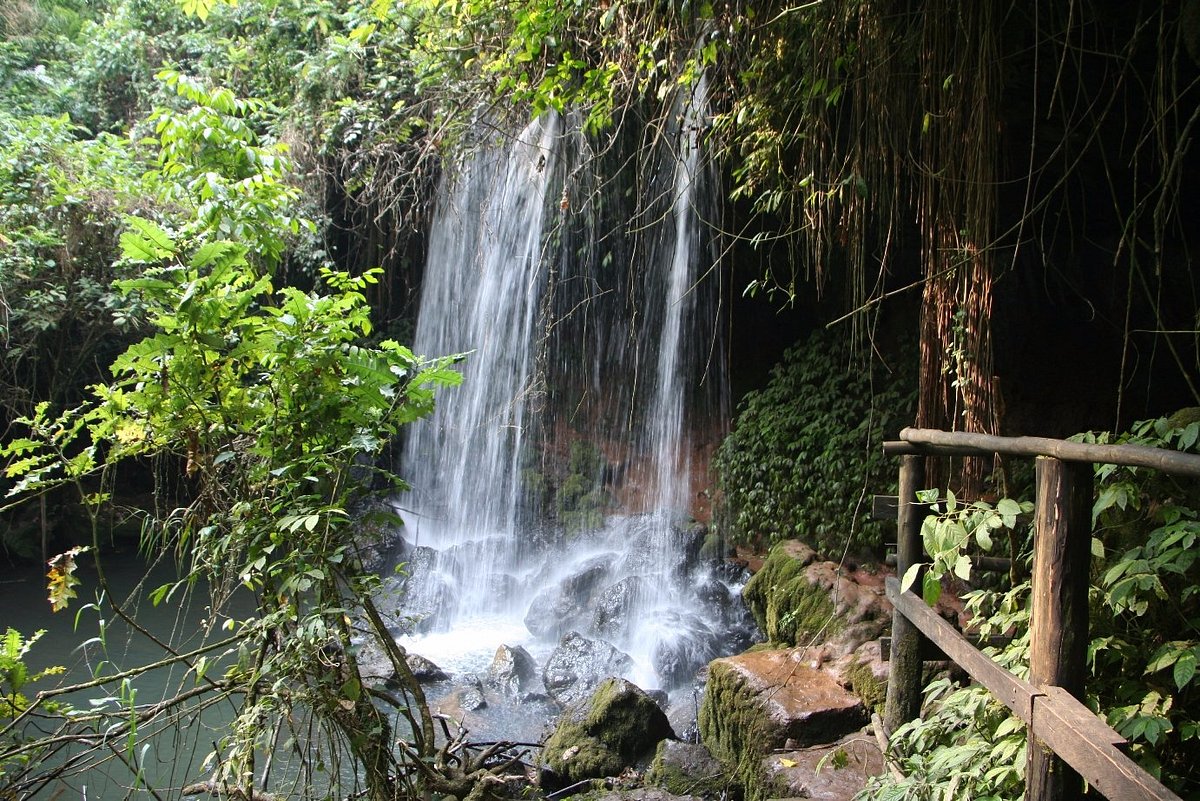
Water flows over the rocky landscape near the caves, creating a cool and green environment.
The combination of dripping limestone, vegetation and waterfalls gives the area a distinctly tropical atmosphere.
After exploring the caves, visitors can spend time around the waterfall and surrounding landscape.
Amabere Caves and the Crater Lakes
One of the advantages of visiting Amabere is that the caves are part of a broader landscape containing crater lakes.
From the area around the caves, visitors can see some of the nearby crater formations and lakes.
This makes it easy to combine the cave visit with a wider crater-lake excursion rather than treating the cave as an isolated attraction.
The Fort Portal Crater Lakes
The crater lakes around Fort Portal are among the region’s most distinctive geographical features.
They were formed through volcanic activity, leaving depressions that later became filled with water.
Today, these crater lakes are scattered among:
Green hills
Farmland
Forests
Tea plantations
Rural communities
The result is a beautiful landscape that is particularly attractive for photography and nature walks.
Fort Portal’s tourism authorities describe the city as being surrounded by more than 50 crater lakes.
Lake Nkuruba
Lake Nkuruba is one of the better-known crater lakes in the Fort Portal area.
Its surroundings offer scenic views and opportunities for nature walks.
The lake is also associated with accommodation and community-based tourism experiences.
For travelers looking for a quieter alternative to a busy safari itinerary, the crater-lake environment around Nkuruba can provide a peaceful stop.
Lake Nyinambuga
Lake Nyinambuga is another well-known crater lake in the Fort Portal region.
Its scenic setting has made it a popular subject for photography.
The surrounding landscape provides the classic Fort Portal crater-lake experience: a deep body of water surrounded by green vegetation and rolling countryside.
Lake Nyabikere
Lake Nyabikere is another important lake within the crater-lake landscape.
It is particularly relevant to travelers exploring the wider Kibale–Fort Portal region.
Its proximity to Kibale also makes it possible to combine crater-lake scenery with chimpanzee trekking and other primate experiences.
Crater Lake Walks
Walking is one of the best ways to appreciate the crater-lake region.
Instead of simply stopping at a viewpoint, travelers can walk through the surrounding countryside and experience the changing landscape.
Depending on the route, you may pass:
Crater lakes
Tea plantations
Farmland
Forest patches
Local communities
Rolling hills
The terrain can be hilly, so comfortable walking shoes are recommended.
Hiking in the Fort Portal Crater Region
Travelers looking for more active experiences can explore some of the hills surrounding the crater lakes.
One of the popular viewpoints is associated with Kyeganywa Hill, where hiking can provide panoramic views over the surrounding countryside.
The combination of elevation and open countryside makes the area particularly rewarding for photographers.
Photography
The Fort Portal region is one of the best places in western Uganda for landscape photography.
Photographers can capture:
Crater lakes
Green hills
Tea plantations
Waterfalls
Limestone formations
Forest
Rural communities
Rwenzori Mountain views
On clear days, the Rwenzori Mountains can provide a dramatic background to the landscape.
Bird Watching
The mixture of forest, farmland, crater lakes and wetlands creates opportunities for bird watching.
Visitors can look for birds around the lake edges, trees and surrounding countryside.
The experience is particularly rewarding when combined with nearby destinations such as Kibale National Park and Bigodi Wetland Sanctuary.
Birders should carry binoculars because many species remain high in trees or move quickly through vegetation.
Tea Plantations Around Fort Portal
Tea is another major part of the Fort Portal landscape.
The surrounding hills are covered in lush tea plantations, creating one of western Uganda’s most recognizable agricultural landscapes.
A drive through the region often reveals long stretches of neatly planted tea bushes.
For travelers interested in agriculture and local livelihoods, a tea plantation visit can add another dimension to the crater-lake experience.
Fort Portal as a Tourism Base
Fort Portal is more than simply the nearest town.
It works as a base for exploring western Uganda.
From the city, travelers can reach:
Kibale National Park
Semuliki National Park
Rwenzori Mountains
Amabere Caves
Crater lakes
Bigodi Wetland Sanctuary
Tooro cultural sites
The city’s location makes it particularly useful for travelers who want to explore several attractions without constantly changing accommodation.
Tooro Kingdom Connection
The landscape around Fort Portal is closely connected with the Tooro Kingdom.
This gives the destination a cultural dimension beyond its scenery.
Travelers can learn about Tooro history, traditions and cultural heritage while exploring the natural attractions surrounding Fort Portal.
The area therefore works particularly well for visitors who want to combine nature and culture in the same itinerary.
Amabere Caves and Tooro Culture
The cultural importance of Amabere is one of its greatest strengths.
The story surrounding Nyinamwiru has been passed through generations and remains part of the cultural interpretation of the site.
A local guide can provide context about the legend, the Tooro Kingdom and the relationship between the natural landscape and local traditions.
This makes a guided visit much more meaningful than simply walking into the cave, taking photographs and leaving.
Best Time to Visit
The Fort Portal region can be visited throughout the year.
The drier periods of June to August and December to February can provide easier conditions for walking and exploring.
However, the rainy seasons also have advantages.
The countryside becomes especially green, waterfalls can be more impressive and the crater-lake landscape takes on a lush appearance.
Travelers should simply be prepared for wet and muddy conditions during periods of heavier rainfall.
How Long Should You Spend?
A short visit to Amabere can take a few hours.
However, if you want to combine:
Amabere Caves
Crater lakes
Hiking
Tea plantations
Fort Portal town
then one to two days gives you a much better experience.
Current destination information similarly suggests around two days for experiencing Fort Portal and its crater-lake surroundings.
Amabere Caves and Kibale National Park
This is one of the strongest combinations.
Kibale National Park is famous for chimpanzee trekking and its exceptional primate diversity.
Amabere and the crater lakes provide a completely different experience.
A traveler can therefore spend one day exploring caves, waterfalls and crater lakes before heading into Kibale for chimpanzee trekking.
This creates a strong western Uganda itinerary.
Amabere Caves and Semuliki National Park
Another excellent combination is Semuliki National Park.
Semuliki offers hot springs, forest and wildlife experiences, while Fort Portal and Amabere provide caves, culture and crater-lake scenery.
The destinations complement each other well.
Fort Portal and Rwenzori Mountains
The Rwenzori Mountains provide a spectacular backdrop to Fort Portal’s landscape.
On clear days, the mountains can be visible from parts of the region.
Travelers who are interested in hiking and mountaineering can combine a Fort Portal stay with a longer Rwenzori trekking adventure.
For travelers who are not planning a major mountain trek, the views alone provide a beautiful addition to the crater-lake experience.
Fort Portal Crater Lakes for Families
The region can be an excellent family destination.
Children can explore caves, see waterfalls, learn about Tooro legends and experience the unusual geography of crater lakes.
The activities can also be adjusted according to the family’s interests and fitness level.
For younger children, short walks and scenic viewpoints may be more appropriate than longer hikes.
Fort Portal Crater Lakes for Couples
The peaceful landscape makes the crater lakes particularly attractive to couples.
A quiet walk around a crater lake, tea plantation views and a scenic lodge overlooking the water can provide a relaxed alternative to a conventional safari.
The area is especially appealing to couples who enjoy nature, photography and slower-paced travel.
What Should You Bring?
For a day exploring Amabere and the crater lakes, consider bringing:
- Comfortable walking shoes
- Drinking water
- Rain jacket
- Insect repellent
- Sunscreen
- Hat
- Camera
- Binoculars
- Light clothing
- Small backpack
Closed shoes are particularly useful for the cave and walking sections.
Is Amabere Caves Worth Visiting?
Yes.
The caves are worth visiting not because they are the largest cave system in Uganda, but because of the combination of geology, waterfalls, Tooro folklore and surrounding scenery.
The experience becomes even more worthwhile when combined with the crater lakes.
Rather than spending a short amount of time at the cave and leaving, travelers should use it as an entry point into the wider Fort Portal landscape.
Are the Fort Portal Crater Lakes Worth Visiting?
Definitely.
The crater lakes provide one of western Uganda’s most scenic landscapes.
They are particularly rewarding for travelers who enjoy:
Nature walks
Photography
Hiking
Bird watching
Peaceful scenery
Cultural experiences
Slow travel
The region also offers a welcome change of pace between Uganda’s larger wildlife destinations.
Who Should Visit?
Amabere Caves and the Fort Portal Crater Lakes are particularly suitable for:
Nature lovers
Photographers
Hikers
Families
Couples
Bird watchers
Culture enthusiasts
Geology enthusiasts
Adventure travelers
Travelers exploring western Uganda
Visitors combining Kibale with other destinations
Frequently Asked Questions
Where Are Amabere Caves?
The caves are located in the Nyakasura area near Fort Portal in western Uganda, roughly 7–9 kilometres from the city depending on the reference point.
What Does Amabere Ga Nyinamwiru Mean?
The name is commonly translated as “the breasts of Nyinamwiru”, referring to the local Tooro legend associated with the limestone formations.
What Can I See at Amabere?
Visitors can see limestone cave formations, stalactites, stalagmites, waterfalls and surrounding crater-lake scenery.
How Many Crater Lakes Are Around Fort Portal?
The wider region contains dozens of crater lakes, with Fort Portal City describing more than 50 in the surrounding area.
Can I Visit Amabere and the Crater Lakes in One Day?
Yes. They are naturally suited to a combined day excursion, although travelers wanting longer walks and multiple crater lakes may prefer more time.
Can I Combine Fort Portal With Kibale?
Yes. Fort Portal is a common base for exploring the wider Kibale region.
Can I See the Rwenzori Mountains From Fort Portal?
The mountains can be visible from the region on clear days, although visibility depends on weather and location.
Is Amabere Suitable for Children?
Yes, although children should be supervised around uneven ground, caves and waterfalls.