








Overview
Bahá’í Temple Kampala – Travel Overview
The Bahá’í Temple Kampala, officially known as the Bahá’í House of Worship, is one of the most distinctive landmarks in Uganda’s capital. Located on Kikaaya Hill, north of central Kampala, the temple rises above extensive landscaped grounds and provides visitors with a peaceful environment away from the noise and activity of the city.
Known within the Bahá’í community as the Mother Temple of Africa, it is the only Bahá’í House of Worship on the African continent. The temple was completed in the early 1960s and has since become both an important place of worship and one of Kampala’s notable tourism attractions.
For travelers, a visit is about more than seeing the building itself. The surrounding gardens, views, architecture, history and atmosphere make the temple a worthwhile stop on a Kampala city tour.

Where Is the Bahá’í Temple?
The Bahá’í Temple is located on Kikaaya Hill, in the northern part of Kampala, along the Gayaza Road area.
Its elevated position makes the building visible from parts of the surrounding city, while the grounds themselves provide a noticeably quieter environment than the busy streets of Kampala.
Its location also makes it relatively easy to combine with other attractions in northern Kampala.
The Mother Temple of Africa
The Kampala Bahá’í Temple is known as the Mother Temple of Africa because it serves as the continental Bahá’í House of Worship for Africa.
The Bahá’í community in Uganda describes the building as the Continental House of Worship in Africa, making it an important institution within the worldwide Bahá’í community.
This gives the temple significance beyond Kampala and Uganda.
For travelers interested in religious heritage, it provides an opportunity to learn about a faith that has been part of Uganda’s history since the mid-20th century.
History of the Bahá’í Temple in Uganda
The Bahá’í Faith was established in Uganda during the early 1950s, with the community growing considerably during that decade. The Kampala House of Worship was subsequently constructed on Kikaaya Hill.
The temple was completed in 1961 and formally dedicated as a House of Worship.
Its construction became an important milestone in the development of the Bahá’í community in Africa.
The temple has remained an important part of Uganda’s religious and architectural heritage for decades.
The Architecture of the Temple
One of the first things visitors notice is the unusual architecture.
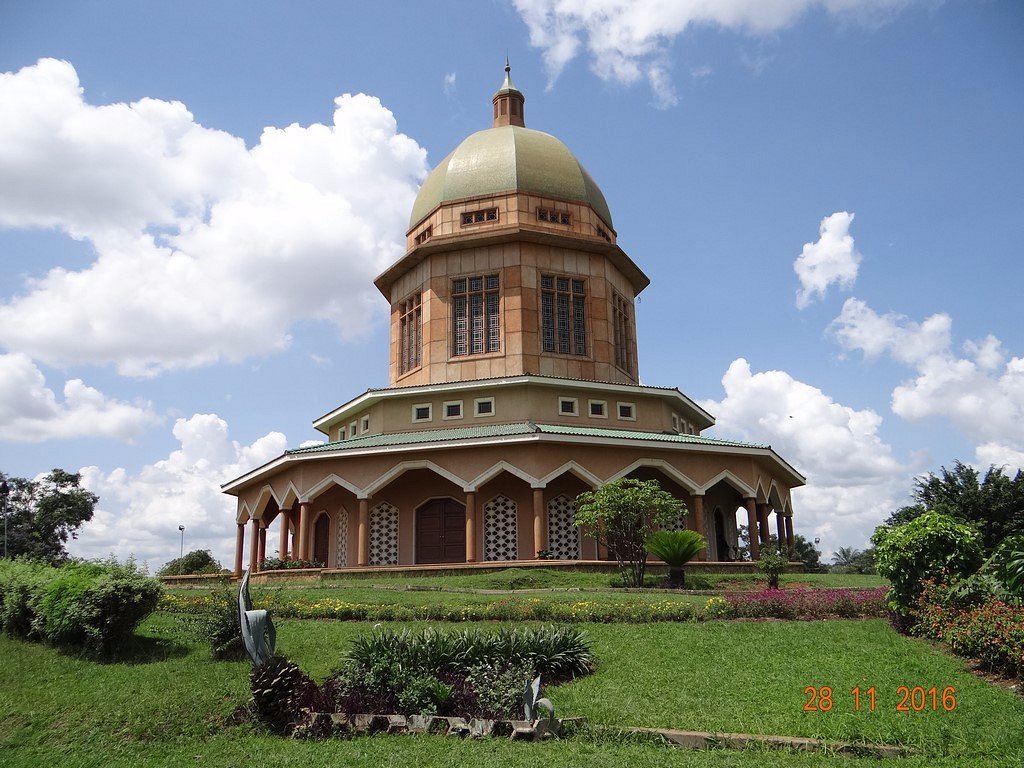
The building has a large green dome rising above a circular structure, surrounded by nine entrances.
The design is not intended simply to create an impressive landmark. The architectural arrangement reflects important Bahá’í ideas concerning unity and the welcoming of people from different backgrounds.
The temple’s nine-sided form and nine entrances are particularly prominent features of its design.
The building itself rises approximately 124 feet, according to tourism descriptions of the site.
The Nine Doors
The temple has nine doors, an important feature of Bahá’í House of Worship architecture.
The number nine has symbolic significance within the Bahá’í tradition, and the entrances contribute to the idea of an open and welcoming place of worship.
Visitors approaching the temple therefore encounter a building designed around openness rather than a single restricted entrance.
The Green Dome
The green dome is arguably the temple’s most recognizable feature.
It rises prominently above the surrounding trees and gardens and has become one of the visual symbols associated with Kampala’s northern skyline.
The dome also makes the temple particularly attractive to photographers.
From different angles around Kikaaya Hill, visitors can capture the building against the gardens, trees and Kampala landscape.
The Temple Gardens
The gardens are an important part of the overall experience.
Rather than surrounding the building with an ordinary urban compound, the temple sits within extensive landscaped grounds containing lawns, flowers, trees and walking paths.
The gardens create a peaceful transition between the busy city outside and the quiet environment around the House of Worship.
Kampala Tourism describes the grounds as a park-like environment where visitors can spend time relaxing and enjoying the surroundings.
A Place of Peace and Reflection
One of the strongest reasons people visit the Bahá’í Temple is simply the atmosphere.
The combination of:
Green gardens
Trees
Flowers
Open lawns
Quiet surroundings
Architecture
creates a peaceful environment within Kampala.
Visitors do not necessarily have to be Bahá’í to appreciate the space.
The temple welcomes people from different backgrounds, reflecting the Bahá’í emphasis on the unity of humanity and religions.
Bahá’í Worship and Prayer
The House of Worship is primarily a place for prayer and devotion.
Visitors entering the temple are expected to respect its religious character.
The environment is intentionally quiet, and visitors should behave appropriately inside the building.
This means the experience is quite different from visiting a conventional tourist attraction.
You are not simply entering an architectural monument—you are entering an active place of worship.
Visiting the Temple Grounds
The grounds provide plenty of space for visitors to walk around and appreciate the landscape.
You can spend time:
Walking through the gardens
Viewing the architecture
Enjoying the peaceful surroundings
Learning about the Bahá’í Faith
Taking photographs from appropriate areas
Reflecting or enjoying some quiet time
The Bahá’í community also has people involved in guiding visitors and explaining the history and significance of the site.
Photography at the Bahá’í Temple
The temple and gardens provide excellent opportunities for photography.
Good subjects include:
The green dome
The nine-sided structure
Garden pathways
Flower beds
Trees
Kampala views
The temple from different angles
However, visitors should respect the rules regarding photography inside the House of Worship.
Previous visitor guidance has specifically stated that photography inside the temple is not permitted, so travelers should follow the current instructions given by staff when they arrive.
Views From Kikaaya Hill
The temple’s elevated location is another attraction.
From Kikaaya Hill, visitors can enjoy views across parts of Kampala and the surrounding landscape.
The combination of the temple’s architecture and the city beyond it creates an interesting contrast between a peaceful religious environment and Kampala’s busy urban landscape.
Bahá’í Temple for Architecture Lovers
You do not have to be interested in religion to appreciate the building.
The temple is particularly interesting for travelers who enjoy:
Architecture
Design
Religious heritage
Landscaping
Photography
The combination of the circular building, green dome, nine entrances and surrounding gardens gives it a distinctive appearance unlike most other buildings in Kampala.
Bahá’í Temple and Religious Tourism
The temple forms an important part of Kampala’s religious tourism landscape.
Visitors exploring the city can combine it with other significant religious sites, including:
Namirembe Cathedral
Rubaga Cathedral
Uganda National Mosque
Namugongo Martyrs Shrine
This provides a broader picture of the different religious traditions represented in Kampala.
KCCA identifies the Bahá’í Temple alongside these sites as part of Kampala’s religious tourism offering.
Bahá’í Temple and Kampala City Tours
The temple is particularly suitable for inclusion in a Kampala city tour.
A city itinerary could combine the temple with historical, cultural and religious attractions across Kampala.
Because the temple is located in the northern part of the city, it can also be paired with attractions such as the Uganda Museum and Ndere Cultural Centre, depending on the route and available time.
Bahá’í Temple for Families
The peaceful gardens can make the temple a pleasant stop for families.
Children can learn about:
Architecture
Religious diversity
Ugandan history
Gardens and plants
Different cultural traditions
Parents should explain that the temple is a functioning place of worship and that visitors are expected to maintain quiet and respectful behavior.
Bahá’í Temple for Couples
The gardens provide a peaceful environment for couples looking for a quieter Kampala experience.
The open lawns, flowers and trees create a pleasant setting for walking and spending time together.
However, visitors should remember that this remains a religious site and should behave respectfully.
Bahá’í Temple for International Travelers
For international visitors, the temple provides a particularly interesting introduction to Uganda’s religious diversity.
It demonstrates that Kampala’s tourism attractions are not limited to markets, museums and historical monuments.
The city also contains places connected to global religious movements and traditions.
Best Time to Visit
The temple can be visited throughout the year.
For photography and enjoying the gardens, morning or late afternoon can be particularly pleasant because of softer light and cooler temperatures.
Visitors should also check current visiting arrangements before making a dedicated trip, especially if they want to attend a particular devotional program or receive a guided introduction.
How Long Should You Spend at the Bahá’í Temple?
You generally do not need an entire day for the temple.
A visit of around one to two hours can allow enough time to:
Explore the gardens
See the temple
Learn about its history
Enjoy the views
Take permitted photographs
It can therefore fit comfortably into a larger Kampala city tour.
What Should You Wear?
There is no need for specialized clothing, but visitors should dress respectfully because this is a place of worship.
Comfortable, modest clothing is recommended.
You should also be prepared for walking around the gardens, particularly if you want to explore the grounds properly.
Rules and Etiquette
Visitors should remember that the Bahá’í Temple is a sacred space.
During your visit:
Keep noise low.
Respect people who are praying.
Follow staff instructions.
Do not pick flowers or plants.
Do not consume alcohol on the grounds.
Do not use intoxicating substances.
Follow current photography restrictions.
Treat the gardens and buildings with care.
These rules help preserve the peaceful character of the site.
Bahá’í Temple and the History of Uganda
The temple is also part of the story of Uganda’s religious development.
The Bahá’í community established itself in Uganda during the 1950s, and the House of Worship became a physical symbol of the community’s growth.
Its continued presence on Kikaaya Hill therefore connects contemporary Kampala with an important chapter in Uganda’s religious history.
Is the Bahá’í Temple Worth Visiting?
Yes.
The Bahá’í Temple offers something different from many of Kampala’s other attractions.
It combines architecture, religious heritage, gardens, history and tranquility in one location.
For first-time visitors to Kampala, it is particularly worthwhile because it demonstrates another side of the city—one where a major religious landmark can sit within beautifully maintained green surroundings just a short distance from the urban center.
If you are building a Kampala city tour, this is definitely one I’d keep on the list.
Who Should Visit the Bahá’í Temple?
The temple is particularly suitable for:
Architecture enthusiasts
Religious tourism travelers
Photographers
History lovers
Couples
Families
Cultural travelers
First-time Kampala visitors
Travelers interested in peaceful city attractions
Frequently Asked Questions
Where Is the Bahá’í Temple Kampala?
It is located on Kikaaya Hill in northern Kampala, in the Gayaza Road area.
What Is the Bahá’í Temple Famous For?
It is famous as the Mother Temple of Africa, its distinctive architecture, green dome, nine entrances and peaceful gardens.
When Was the Bahá’í Temple Built?
The House of Worship was completed in 1961.
Can Anyone Visit the Bahá’í Temple?
The temple welcomes visitors from different religious and cultural backgrounds. Visitors are expected to respect the religious nature of the site.
Can I Take Photos Inside?
Visitors should follow the current instructions given by temple staff. Previous visitor guidance states that photography inside the temple is prohibited, while the exterior and gardens provide photography opportunities.
How Long Should I Spend There?
Around one to two hours is generally enough for exploring the temple and gardens as part of a Kampala city tour.
Can I Combine It With Other Kampala Attractions?
Yes. It can easily be combined with attractions such as the Uganda Museum, Ndere Cultural Centre and other Kampala religious and cultural sites.