






Overview
Bigodi Wetland Sanctuary – Travel Overview
Bigodi Wetland Sanctuary is one of western Uganda’s most rewarding community-based nature destinations, located beside Kibale National Park in the Fort Portal region. The sanctuary protects part of the Magombe Wetland and offers travelers an opportunity to explore wetlands, forests and village landscapes while looking for primates, birds, butterflies and other wildlife.
What makes Bigodi particularly special is that the experience goes beyond wildlife viewing. The sanctuary is managed through Kibale Association for Rural and Environmental Development (KAFRED), a community-based organization established in 1992. Tourism revenue supports conservation and community initiatives, making a visit an opportunity to experience both nature and local livelihoods.
For travelers visiting Kibale National Park, Bigodi is an excellent complementary experience. While Kibale is famous for chimpanzee trekking, Bigodi offers a slower guided walk through wetland habitat, with a strong emphasis on birding, primates, plants and community tourism.
Where Is Bigodi Wetland Sanctuary?
Bigodi Wetland Sanctuary is located in Bigodi village, close to Kibale National Park in western Uganda.
The sanctuary is roughly 40 kilometres from Fort Portal, while the Kanyanchu tourism area of Kibale National Park is approximately 6 kilometres away.
This location makes Bigodi easy to include in a western Uganda itinerary covering Kibale, Fort Portal and the surrounding crater lakes.
What Is Bigodi Wetland Sanctuary?
Bigodi is a community-managed wetland conservation area surrounding part of the Magombe Swamp.
The wetland is an important habitat for birds, primates and other wildlife and also functions as a wildlife corridor connected to the wider Kibale landscape. KAFRED’s history notes that the wetland stretches for approximately 8 kilometres and connects with Kibale National Park at both ends.
Rather than being a conventional national park, Bigodi is a community-based tourism project.
That distinction is important.
Your visit contributes directly to a conservation model in which local residents benefit economically from protecting the wetland.
The Bigodi Wetland Walk
The main experience is the guided nature walk through the wetland.
The official Bigodi tourism organization describes the trail as approximately 4.5 kilometres and taking up to around three hours. Visitors pass through wetland vegetation, forest sections and boardwalk areas while accompanied by trained local guides.
The walk is not simply about reaching a particular attraction.
The guide helps travelers interpret what they encounter along the way, from bird calls and plants to primates and other wildlife.
This makes the experience particularly rewarding for travelers who enjoy learning about an ecosystem rather than simply photographing animals.
Primates of Bigodi
Primates are one of the main attractions of Bigodi Wetland Sanctuary.
The sanctuary is known for several species, including:
Red colobus monkeys
Black-and-white colobus monkeys
Red-tailed monkeys
Blue monkeys
Grey-cheeked mangabeys
L’Hoest’s monkeys
Vervet monkeys
Olive baboons
The exact species seen during a walk naturally depends on where the animals are at the time of your visit.
Watching monkeys moving through the vegetation can be one of the most memorable parts of the walk.
Can You See Chimpanzees at Bigodi?
Chimpanzees are primarily associated with the neighboring Kibale National Park, where visitors can participate in dedicated chimpanzee trekking experiences.
Chimpanzees may occasionally move into or near the Bigodi wetland, but sightings should not be treated as guaranteed.
This distinction is important when planning a safari.
Visit Kibale for dedicated chimpanzee trekking.
Visit Bigodi for a broader wetland, primate and birding experience.
The two experiences complement each other extremely well.
Bird Watching at Bigodi
For birders, Bigodi is one of the strongest attractions in the Kibale region.
The sanctuary supports more than 200 bird species, according to the local tourism organization and Ugandan government tourism information.
Among the most famous birds associated with Bigodi is the spectacular Great Blue Turaco.
Other birds found around the wetland include various:
Kingfishers
Hornbills
Turacos
Parrots
Cranes
Weavers
and other wetland and forest species.
For serious birders, hiring a knowledgeable local guide can make a major difference because many forest and wetland birds are easier to identify by their calls than by sight.
The Great Blue Turaco
The Great Blue Turaco is one of Bigodi’s signature birds.
Its striking blue, green and red coloration makes it a favorite among photographers and bird watchers.
It is also represented in KAFRED’s emblem, reflecting the bird’s importance to the sanctuary and its conservation identity.
Seeing one in the wild is often a highlight for visitors interested in Ugandan birdlife.
However, like any wild species, sightings cannot be guaranteed.
Other Wildlife at Bigodi
The wetland supports more than birds and monkeys.
Visitors may encounter animals such as:
Sitatungas
Bushbucks
Otters
Bush pigs
Mongooses
along with other small mammals and wetland species.
The open wetland environment can sometimes make wildlife easier to spot than in dense forest.
Nature and Plant Life
Bigodi is also an interesting destination for travelers interested in plants.
The wetland contains a mixture of aquatic vegetation, forest plants and other vegetation adapted to the swamp environment.
Local guides can explain the traditional uses of some plants, including plants associated with medicine and local knowledge.
This adds an educational dimension to the walk that is easy to miss if you explore the area without a guide.
Bigodi Community Walk
Bigodi offers more than the wetland itself.
Travelers can participate in a community or cultural village walk that introduces visitors to everyday life in the surrounding community.
The experience can include encounters with local traditions, food, crafts, farming and traditional knowledge.
The official Bigodi tourism organization currently lists both a Guided Nature Walk and a Cultural Village Walk among its bookable experiences.
Traditional Knowledge and Medicinal Plants
One interesting part of the community experience is learning about traditional plant knowledge.
Local guides and community members can explain how certain plants have historically been used for medicinal or practical purposes.
This provides a different perspective on the forest.
Instead of seeing vegetation simply as scenery, travelers learn how local communities have traditionally interacted with and depended upon their environment.
Local Food and Culture
A community visit can also introduce travelers to local food and everyday life.
Depending on the experience arranged, visitors may encounter traditional cooking, local crops and household activities.
This is one of the reasons Bigodi works particularly well for travelers who want to experience Uganda beyond wildlife.
The destination allows visitors to meet people and understand the communities living alongside one of the country’s most important forest ecosystems.
Women and Community Enterprises
Community tourism around Bigodi has created opportunities for local groups, including women’s groups involved in crafts and other small businesses.
KAFRED’s community information describes tourism-related employment and markets for locally produced products as part of the economic benefits associated with conservation.
Travelers can therefore support the community by using local guides and purchasing genuinely locally made crafts where appropriate.
Conservation at Bigodi
Conservation is central to the Bigodi experience.
KAFRED was established partly to protect the wetland while creating economic benefits for surrounding communities.
The organization’s model links conservation, tourism and community development.
Tourism revenue has supported projects involving education, water access, sanitation and other community needs.
This makes Bigodi a useful example of how tourism can provide an economic reason for communities to protect natural ecosystems.
Bigodi as a Wildlife Corridor
The wetland has ecological importance beyond tourism.
KAFRED describes Bigodi as a corridor for animals moving between parts of the Kibale landscape.
Protecting the wetland therefore helps maintain connectivity between habitats.
For travelers, this means the walk is not simply through an isolated swamp. It is part of a wider ecosystem connected to one of Uganda’s most important primate forests.
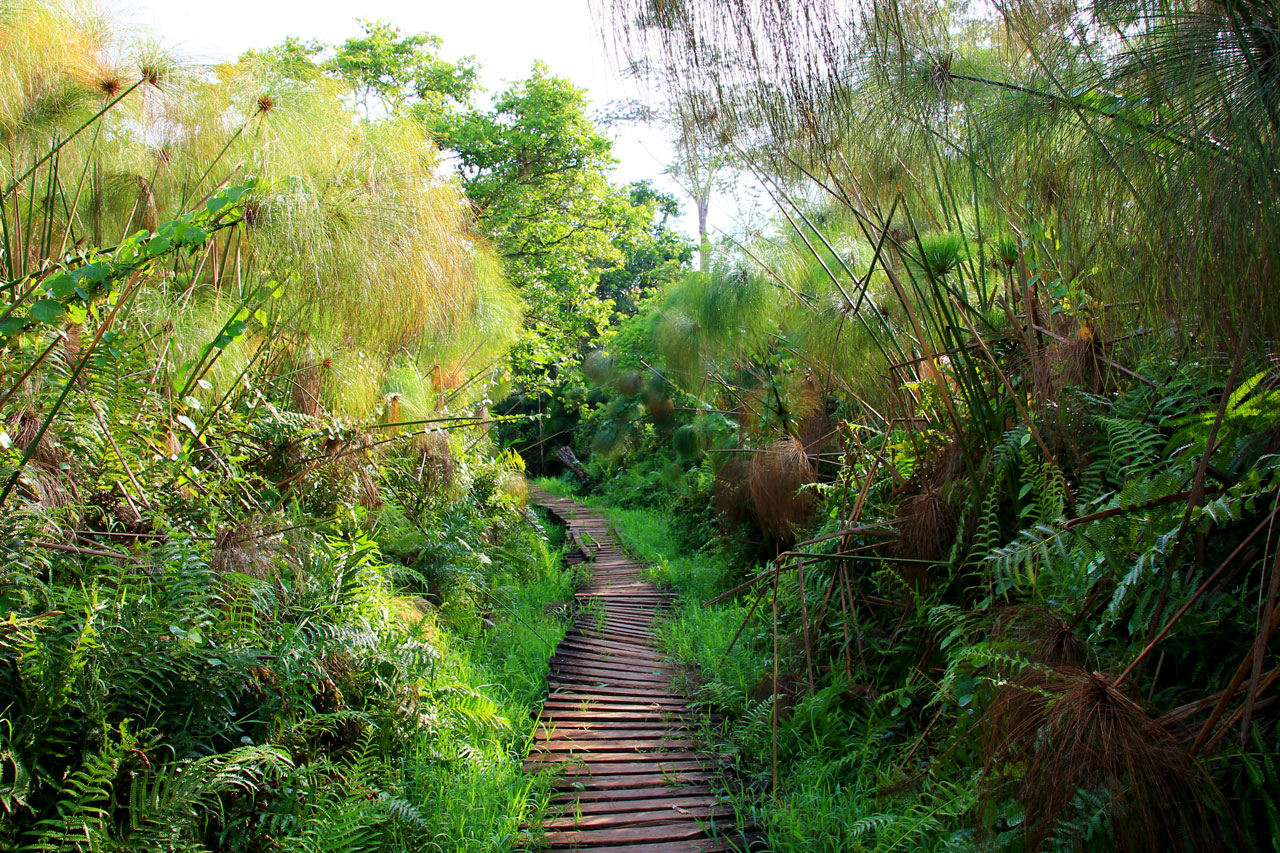
The Boardwalks
Parts of the wetland walk use raised boardwalks and bridges.
These allow visitors to move through wet areas while minimizing disturbance to the environment.
They also provide good viewing points for birds, vegetation and other wildlife.
During wet weather, however, sections of the trail can become slippery, so proper footwear is recommended.
Bigodi for Photographers
Bigodi is an excellent destination for nature photography.
The variety of subjects means photographers can move between wildlife and landscapes throughout the walk.
Potential subjects include:
Great Blue Turacos
Colobus monkeys
Red-tailed monkeys
Wetland vegetation
Boardwalks
Local people and village scenes
Butterflies
Lake and wetland landscapes
A telephoto lens is useful for primates and birds, while a wider lens works well for the landscape and boardwalk scenes.
Bigodi for Bird Watchers
If birding is your main reason for visiting, consider starting early.
Morning walks generally offer cooler temperatures and active birdlife.
A knowledgeable local guide can also help identify species by sound.
The official sanctuary information recommends morning starts around 7:30–9:00am, with another common afternoon start around 3:00pm.
How Long Does the Bigodi Walk Take?
The main guided nature walk takes approximately three hours.
The official sanctuary describes the walking route as about 4.5 kilometres.
That makes Bigodi relatively easy to incorporate into a busy safari itinerary.
You can spend the morning exploring the wetland and then continue with another activity in the Kibale or Fort Portal region.
Best Time to Visit Bigodi Wetland Sanctuary
Bigodi can be visited throughout the year.
The drier periods, particularly December to February and June to August, can provide easier walking conditions.
However, the wetland remains attractive during rainy periods.
The vegetation becomes particularly lush, although trails and boardwalks can become wet and slippery.
For birders, choosing the time of day carefully may be more important than choosing a particular season.
Bigodi Wetland Sanctuary and Kibale National Park
These two destinations belong together in a western Uganda itinerary.
Kibale National Park provides the famous chimpanzee trekking experience.
Bigodi Wetland Sanctuary provides a community-led wetland experience featuring birds, primates, plants and local culture.
Rather than choosing one over the other, travelers with enough time should consider visiting both.
It gives you two different perspectives on the same wider ecosystem.
Bigodi and Fort Portal
Bigodi is also easy to combine with Fort Portal.
Fort Portal is a useful base for exploring the region’s crater lakes, tea plantations, cultural attractions and nearby national parks.
A traveler staying in Fort Portal can therefore use the city as a starting point for a Bigodi excursion.
The broader Fort Portal area is promoted as a major tourism destination because of its proximity to Kibale, Bigodi, the crater lakes and other western Uganda attractions.
Bigodi and Amabere Caves
Travelers exploring the Fort Portal area can combine Bigodi with Amabere Caves.
The two destinations provide very different experiences.
At Amabere, the focus is on limestone caves, waterfalls and Tooro cultural traditions.
At Bigodi, the focus is wetland ecology, birds, primates and community tourism.
Together, they make a varied western Uganda excursion.
Bigodi for Families
Bigodi can be a great family experience, particularly for children interested in animals and nature.
The guided walk provides opportunities to see monkeys and birds while learning about the wetland ecosystem.
The community walk can also introduce children to aspects of Ugandan rural life that they may not encounter elsewhere on a safari.
Parents should ensure children remain with the guide and avoid making loud noises around wildlife.
Bigodi for Couples
For couples, Bigodi offers a quieter experience compared with a traditional game drive.
Walking together through the wetland, watching birds and monkeys and then experiencing the surrounding community creates a relaxed and intimate addition to a safari.
It works particularly well between more demanding activities such as chimpanzee trekking and long-distance travel.
What Should You Bring?
For a Bigodi Wetland walk, bring:
- Comfortable walking shoes
- Lightweight clothing
- Long trousers
- Insect repellent
- Sunscreen
- Hat
- Drinking water
- Binoculars
- Camera
- Rain jacket
- Small backpack
Binoculars are especially worthwhile if birding is one of your priorities.
Responsible Tourism at Bigodi
Because Bigodi is both a conservation area and a community tourism project, responsible behavior is important.
Visitors should:
Stay on designated trails and boardwalks.
Follow the guide’s instructions.
Do not feed wildlife.
Avoid disturbing birds and primates.
Do not litter.
Ask permission before photographing local people.
Support local guides and community businesses.
Avoid removing plants or other natural materials.
The sanctuary’s conservation model depends on maintaining the wetland while ensuring tourism benefits the surrounding community.
Is Bigodi Wetland Sanctuary Worth Visiting?
Absolutely—especially if you are already visiting Kibale National Park.
Bigodi does not compete with Kibale’s chimpanzee trekking.
It offers something different.
The sanctuary brings together wetland scenery, birds, primates, local culture and community conservation in one guided experience.
For travelers who want to understand how wildlife conservation connects with local communities, Bigodi is particularly valuable.
It is also a good choice for travelers who enjoy walking rather than spending every day inside a safari vehicle.
Who Should Visit Bigodi?
Bigodi Wetland Sanctuary is especially suitable for:
Bird watchers
Nature lovers
Photographers
Primate enthusiasts
Families
Couples
Culture enthusiasts
Community-tourism travelers
Eco-conscious travelers
Travelers visiting Kibale National Park
Travelers exploring Fort Portal
Frequently Asked Questions
Where Is Bigodi Wetland Sanctuary?
Bigodi is located in western Uganda near Kibale National Park, approximately 40 kilometres from Fort Portal.
What Can I See at Bigodi?
You can see numerous bird species, primates, wetland vegetation and other wildlife. The Great Blue Turaco is one of the sanctuary’s signature birds.
How Long Is the Bigodi Wetland Walk?
The official sanctuary describes the guided nature walk as approximately 4.5 kilometres and taking up to three hours.
Can I See Chimpanzees at Bigodi?
Chimpanzees primarily belong to the neighboring Kibale ecosystem. They may occasionally enter the wetland, but Bigodi should not be booked as a guaranteed chimpanzee trekking experience.
Is Bigodi Part of Kibale National Park?
Bigodi Wetland Sanctuary is a community-managed wetland outside the main national park boundary, adjacent to Kibale.
Is Bigodi Good for Bird Watching?
Yes. The sanctuary supports more than 200 bird species and is particularly famous for the Great Blue Turaco.
Can I Combine Bigodi With Chimpanzee Trekking?
Yes. Combining Bigodi with Kibale chimpanzee trekking is one of the best ways to experience the region.
Can I Visit Bigodi From Fort Portal?
Yes. Fort Portal is a convenient base for exploring Bigodi and other attractions in the surrounding region.