








Overview
Kyambura Gorge – Travel Overview
Kyambura Gorge is one of the most distinctive natural attractions within the Queen Elizabeth Conservation Area in southwestern Uganda. Often called the “Valley of Apes,” the gorge cuts dramatically through the savannah landscape before reaching the Kazinga Channel area.
What makes Kyambura particularly remarkable is the contrast between its surroundings and its interior. From above, the landscape is dominated by open savannah, but deep inside the gorge lies a belt of riverine forest along the Kyambura River. UWA describes the gorge as a spectacular geological feature created by faulting associated with the formation of the Rift Valley.
The gorge is especially famous for chimpanzee tracking, but the experience is not simply about seeing chimpanzees. It combines primate tracking, forest exploration, dramatic scenery and an opportunity to experience one of the unusual ecosystems within Queen Elizabeth National Park.
Where Is Kyambura Gorge?
Kyambura Gorge is located in Queen Elizabeth National Park in southwestern Uganda, within the Queen Elizabeth Conservation Area.
The gorge lies within the eastern part of the park and is associated with the Kyambura River, which eventually flows toward the Kazinga Channel. UWA describes the gorge as extending through the savannah landscape and having steep sedimentary-rock walls rising to around 100 metres in places.
Its location makes it easy to incorporate into a broader Queen Elizabeth safari.
A traveler can therefore combine chimpanzee tracking at Kyambura with traditional wildlife viewing, a Kazinga Channel boat cruise and other experiences within Queen Elizabeth National Park.
What Makes Kyambura Gorge Special?
The most striking feature of Kyambura is its dramatic change in landscape.
You can be standing in open savannah and then descend into a deep gorge containing dense vegetation and a flowing river.
UWA describes the gorge as extending for approximately 16 kilometres, with steep sides reaching around 100 metres at the highest sections near Fig Tree Camp. The gorge varies in width from roughly 50 to 150 metres.
Inside the gorge is what UWA describes as an “underground” rainforest—a belt of riparian forest hidden within the surrounding savannah.
That unusual combination of savannah above and forest below is what gives Kyambura much of its character.
The Kyambura Gorge Forest
The forest inside the gorge is closely associated with the Kyambura River.
The river provides moisture that supports a strip of dense vegetation within an otherwise predominantly savannah environment.
This creates habitat for primates, birds and other wildlife.
The forest is not an enormous continuous rainforest like Bwindi or Kibale. Instead, it is a relatively narrow forested ecosystem enclosed by the gorge.
That distinction is important because travelers should not expect the same type of forest experience they would have in Kibale or Bwindi.
Kyambura offers something different: a forest hidden inside a dramatic Rift Valley gorge.
Chimpanzee Tracking in Kyambura Gorge
Chimpanzee tracking is the main tourist experience associated with Kyambura Gorge.
UWA’s current chimpanzee-tracking guidelines identify Kyambura in Queen Elizabeth National Park as one of the designated entry sectors for tracking habituated chimpanzees in UWA-managed protected areas.
The experience involves entering the forest with UWA guides and searching for habituated chimpanzees.
Unlike observing wildlife from a safari vehicle, chimpanzee tracking requires visitors to move through the forest on foot.
You may follow trails, listen for calls and search the vegetation for movement overhead.
When the chimpanzees are located, the experience provides an opportunity to observe their behavior in their natural environment.
How Long Is Chimpanzee Tracking?
UWA’s current guidelines state that normal chimpanzee tracking takes place from 8:00 a.m. for morning tracking and 2:00 p.m. for afternoon tracking, continuing until visitors return to the briefing point.
The guidelines also specify a maximum viewing time of one hour once the chimpanzees are encountered during normal tracking.
This is different from the chimpanzee habituation experience, which has a longer permitted viewing period.
So when planning a website page about Kyambura, it is better to distinguish between normal chimpanzee tracking and chimpanzee habituation rather than treating them as the same activity.
The Chimpanzees of Kyambura
Kyambura’s chimpanzees are particularly interesting because they live in an isolated forest environment surrounded by savannah.
UWA’s Queen Elizabeth Protected Area management plan describes a small, isolated group of chimpanzees within the gorge and notes that other primates also occur there.
Chimpanzee sightings cannot be guaranteed.
These are wild animals, and their movements depend on food availability, weather and other ecological factors.
That is part of what makes tracking different from visiting an enclosure or zoo.
You enter the forest knowing that the animals determine where the encounter happens.
Other Primates in Kyambura Gorge
Chimpanzees are not the only primates found in the gorge.
UWA’s conservation plan records species including:
- Red-tailed monkeys
- Black-and-white colobus monkeys
- Vervet monkeys
- Olive baboons
within the Kyambura environment.
This means even when chimpanzees are difficult to locate, the forest can still provide interesting primate encounters.
For travelers interested in Uganda’s primate diversity, Kyambura therefore provides an excellent complement to destinations such as Kibale.
Wildlife Around Kyambura Gorge
Kyambura is not only a primate habitat.
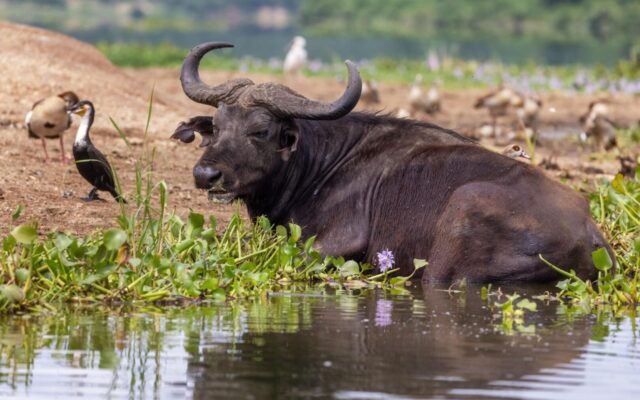
UWA’s Queen Elizabeth management plan records larger mammals such as elephants, hippos, buffaloes and lions using the gorge and surrounding area.
These animals are not necessarily encountered during a chimpanzee trek, however.
The chimpanzee experience takes place within the gorge forest, while larger mammals are more appropriately encountered during wildlife viewing elsewhere within Queen Elizabeth National Park.
This distinction is important when planning a safari.
Bird Watching in Kyambura Gorge
The forest and riverine vegetation provide habitat for numerous bird species.
The surrounding Queen Elizabeth ecosystem itself contains a wide variety of habitats, including savannah, forests, wetlands and crater environments.
For birders, Kyambura can therefore complement other birding locations within the park.
However, travelers visiting specifically for birding should consider spending additional time in other parts of Queen Elizabeth National Park because the wider protected area offers considerably more habitat diversity.
The Kyambura River
The Kyambura River is one of the defining features of the gorge.
It flows along the floor of the gorge and eventually connects with the Kazinga Channel system.
The river is responsible for helping maintain the lush vegetation found within the gorge.
As you descend, the presence of water and dense vegetation becomes increasingly noticeable, creating a striking contrast with the dry-looking savannah above.
The river also contributes to the atmospheric quality of the chimpanzee-tracking experience.
The Kyambura Gorge Viewpoint
One of the attractions of visiting the area is the opportunity to look down into the gorge from above.
The viewpoint provides an impressive perspective of the deep ravine and the forest below.
From this position, the scale of the gorge becomes much easier to appreciate.
You can see how dramatically the landscape changes from the surrounding savannah into the forested river valley.
For photographers, the viewpoint can provide excellent landscape compositions.
The Rift Valley Landscape
Kyambura’s formation is closely connected to the geological history of the Albertine Rift.
UWA identifies the gorge as one of Queen Elizabeth National Park’s important scenic landforms, created through faulting associated with Rift Valley formation and volcanic activity.
This geological background helps explain why the gorge is so dramatically different from the surrounding landscape.
It is not simply a forest valley.
It is a geological feature that has created a unique ecological environment.
Physical Demands of Chimpanzee Tracking
Chimpanzee tracking at Kyambura takes place on foot and involves descending into and climbing out of the gorge.
That means travelers should be prepared for uneven terrain, slopes and potentially muddy conditions.
UWA notes that chimpanzee tracking conditions vary seasonally, and its Queen Elizabeth information specifically mentions that chimpanzee tracking takes place throughout the year.
During wetter conditions, trails can become slippery.
Good hiking shoes, drinking water and appropriate clothing are therefore important.
The trek should be approached as a forest hike, not as a simple walk through a flat park.
Best Time to Visit Kyambura Gorge
Chimpanzee tracking takes place throughout the year according to UWA.
The experience can, however, vary with the season.
During the wetter periods, forest conditions can become muddy, but UWA notes that chimpanzees may be easier to track because they tend to remain closer to areas with food.
During drier periods, the chimpanzees may move deeper into the forest in search of food.
So there isn’t one simple answer that one season is always best.
The choice depends partly on whether the traveler prioritizes easier hiking conditions or potentially more favorable chimpanzee-tracking conditions.
How to Get to Kyambura Gorge
Kyambura Gorge is reached as part of a journey to Queen Elizabeth National Park.
UWA places Queen Elizabeth National Park approximately 410 kilometres from Kampala, with a direct drive taking roughly 7–8 hours, although an actual safari itinerary will often take longer because travelers usually make stops or visit other destinations along the way.
The park can also be reached by air, with UWA identifying nearby airstrips including Kasese, Mweya and Kihihi, depending on the itinerary and sector being visited.
Once within the Queen Elizabeth area, travelers proceed toward the Kyambura sector for chimpanzee tracking.
Accommodation Near Kyambura Gorge
There is accommodation in the broader Kyambura and Queen Elizabeth area.
One officially licensed example listed by the Uganda Tourism Board is Kyambura Gorge Lodge, which is located in the area and provides accommodation for travelers visiting the gorge and Queen Elizabeth ecosystem.
There are also other lodges and camps around Queen Elizabeth National Park, meaning travelers can choose accommodation according to their budget and safari itinerary.
For a chimpanzee-tracking itinerary, staying relatively close to the Kyambura sector can be convenient because it reduces unnecessary early-morning driving.
Kyambura Gorge and Queen Elizabeth National Park
Kyambura makes the most sense when experienced as part of a Queen Elizabeth safari.
The park offers a much broader range of wildlife and landscapes than the gorge alone.
A traveler can combine:
Chimpanzee tracking at Kyambura
with:
Game drives
Kazinga Channel boat cruises
Crater-lake scenery
Savannah wildlife viewing
and other experiences within the park.
UWA identifies Queen Elizabeth as a highly biodiverse protected area with more than 95 mammal species and more than 600 bird species.
That makes the gorge an excellent primate component within a much larger safari experience.
Kyambura Gorge and Kibale National Park
Kyambura is often compared with Kibale National Park because both offer chimpanzee experiences.
The important difference is that Kibale is much more strongly established as Uganda’s premier chimpanzee-tracking destination, while Kyambura provides a more distinctive experience combining chimpanzee tracking with a dramatic gorge and savannah setting.
For travelers who have enough time, visiting both can provide an interesting comparison.
Kibale offers the extensive tropical forest environment, while Kyambura offers the unusual experience of entering a forest hidden within a Rift Valley gorge.
Is Kyambura Gorge Worth Visiting?
Yes—particularly for travelers who want to add a primate experience to a Queen Elizabeth safari.
The strongest reason to visit is not simply the possibility of seeing chimpanzees.
It is the whole environment.
You descend from savannah into a deep gorge.
You walk through a riverine forest.
You listen for chimpanzee calls.
You search the trees for movement.
And all around you is a landscape shaped by the geological forces that created the Albertine Rift.
That combination makes Kyambura different from a standard chimpanzee-tracking destination.
Why Visit Kyambura Gorge?
Kyambura Gorge brings together several experiences that are rarely found in one place.
It offers:
Chimpanzee tracking in a UWA-designated tracking sector.
A dramatic Rift Valley gorge with steep walls reaching around 100 metres.
A hidden riverine forest surrounded by savannah.
Several primate species, including red-tailed and black-and-white colobus monkeys.
Easy integration with Queen Elizabeth National Park’s wider safari experiences.
For someone visiting southwestern Uganda, it can therefore be much more than just another stop on the itinerary.
Frequently Asked Questions
What Is Kyambura Gorge Famous For?
Kyambura Gorge is best known for its chimpanzee tracking experience and its dramatic forest-filled gorge within Queen Elizabeth National Park.
Is Kyambura Gorge Inside Queen Elizabeth National Park?
Yes. The gorge is part of the Queen Elizabeth Conservation Area and is associated with Queen Elizabeth National Park.
Can I Track Chimpanzees at Kyambura Gorge?
Yes. UWA currently identifies Kyambura as a designated sector for chimpanzee tracking.
How Long Is Chimpanzee Tracking?
UWA’s current guidelines allow normal chimpanzee tracking from 8:00 a.m. for morning tracking and 2:00 p.m. for afternoon tracking, with a maximum one-hour viewing period once the chimpanzees are encountered.
Are There Other Primates at Kyambura?
Yes. UWA records red-tailed monkeys, black-and-white colobus monkeys, vervet monkeys and olive baboons in the gorge environment.
Is Kyambura Gorge Difficult to Hike?
The trek involves descending into and climbing out of a deep gorge, so visitors should be prepared for uneven and potentially muddy terrain.
Can Kyambura Be Combined With a Safari?
Absolutely. It fits particularly well into a Queen Elizabeth National Park itinerary combining chimpanzee tracking with game drives and the Kazinga Channel experience.
Where Can I Stay Near Kyambura Gorge?
Accommodation is available around the gorge and wider Queen Elizabeth area, including the officially licensed Kyambura Gorge Lodge.