









How Much Does a Self-Drive Uganda Safari Cost?
A self-drive Uganda safari gives travelers something that a conventional guided safari cannot quite provide: control over the journey.
Instead of traveling with a driver-guide throughout the trip, you rent a suitable vehicle and drive yourself through Uganda’s national parks, towns, countryside and scenic routes.
For adventurous travelers, this can be an exciting way to experience Uganda.
You decide when to leave your lodge, where to stop, how long to spend at a viewpoint and which destinations to include.
But there is an important misconception about self-drive safaris.
Self-drive does not mean free or extremely cheap travel.
The rental vehicle is only one part of the budget.
You still need to pay for fuel, accommodation, food, park entrance fees, vehicle entry fees and activities such as boat cruises, chimpanzee trekking or gorilla trekking.
For a 2026 Uganda self-drive safari, a realistic vehicle budget can start at approximately US$40–70 per day for a basic 4×4, while more capable safari vehicles such as Land Cruisers can range from around , depending on the vehicle and rental conditions. Current market listings show RAV4 rates around US$40–70 and Land Cruiser options commonly ranging from approximately US$80 upward.
Once fuel, accommodation, park fees and activities are added, a couple traveling independently might reasonably budget around US$150–300+ per person per day for a comfortable self-drive safari, excluding international flights and major specialty permits.
A budget traveler camping and using a basic 4×4 could spend less.
A traveler using a premium Land Cruiser, upscale lodges and several major activities could spend considerably more.
The biggest advantage is that self-drive allows you to control many of those expenses.
How Much Does It Cost to Rent a Self-Drive 4×4 in Uganda?
The vehicle is usually the first expense to consider.
Uganda’s major highways are generally accessible with ordinary vehicles, but once you leave the main roads and enter national parks, the situation changes.
Safari tracks can be uneven, muddy, steep and heavily rutted, particularly during rainy periods.
This is why a proper 4×4 is strongly recommended for serious self-drive safaris.
Current 2026 rental listings provide a useful picture of the market.
A Toyota RAV4 can be found from roughly US$40–70 per day, depending on the operator, season and rental duration. A Prado can fall around US$60–130+ per day, while more specialized safari Land Cruisers can reach US$100–200 or more per day.
Another current Uganda rental provider lists RAV4s around US$50–65 per day and Land Cruiser models at higher rates, while some companies advertise rates that include insurance, roadside assistance and unlimited mileage.
That last part is important.
Never compare rental prices based only on the daily rate.
A US$50 vehicle with expensive mileage restrictions, limited insurance and additional charges may ultimately cost more than a US$65 vehicle with comprehensive inclusions.
Toyota RAV4 vs Land Cruiser for a Uganda Self-Drive Safari
The choice of vehicle can make a surprisingly large difference to the experience.
A Toyota RAV4 is often one of the more affordable options and can work well for travelers following good roads and lighter safari routes.
It can be particularly suitable for couples or small groups who want to visit destinations such as Lake Mburo and travel between major towns.
However, if your itinerary includes more challenging terrain, a larger 4×4 can provide additional ground clearance, traction and carrying capacity.
A Toyota Land Cruiser Prado offers a useful middle ground between affordability and capability.
A dedicated safari Land Cruiser with a pop-up roof takes things further.
The elevated viewing position is useful during game drives because you can see over vegetation and enjoy a more traditional safari setup.
For a serious national-park itinerary involving Bwindi, Queen Elizabeth, Murchison Falls or Kidepo, travelers should discuss the planned route with the rental company before selecting a vehicle.
Current Uganda rental guidance consistently recommends proper 4×4 vehicles for national-park tracks and remote areas.
Does Self-Drive Rental Include Insurance?
This is one of the most important questions to ask before booking.
Insurance arrangements differ between rental companies.
Some current Uganda rental providers advertise comprehensive insurance, roadside assistance and other inclusions in their rates, while others may have different coverage levels and conditions.
You should therefore ask exactly what the insurance covers.
Don’t simply ask:
“Is insurance included?”
Ask:
“What type of insurance is included, what is my excess, and what happens if the vehicle is damaged on a rough park track?”
That question is much more useful.
You should also establish whether tires, windscreen damage, underbody damage and recovery costs are covered.
A safari vehicle is operating in a very different environment from a normal city rental car.
Fuel Costs for a Self-Drive Uganda Safari
Fuel is another major part of the budget.
The amount you spend depends on the vehicle, route and total distance.
A RAV4 generally consumes less fuel than a heavy Land Cruiser, while a vehicle loaded with camping equipment may consume more.
Long-distance routes also add up quickly.
For example, traveling from Entebbe toward western Uganda and then continuing between several parks can involve hundreds of kilometers.
Kidepo is an even bigger consideration because of its remote location.
This is why your fuel budget should be calculated from your actual route, not simply by multiplying a daily estimate by the number of safari days.
A useful approach is to map the planned route, estimate the total kilometers and then allow additional fuel for game drives and local movements.
National park game drives can add substantial distance because you’re not only driving between cities.
You’re also spending hours inside the park.
Uganda National Park Fees for Self-Drive Travelers
Another important cost is the national park entrance fee.
Self-drive travelers should remember that they are responsible for paying their own applicable park fees unless these have been included through a package or other arrangement.
There is also a separate vehicle entry charge.
The Uganda Wildlife Authority tariff currently covering July 2024–June 2026 lists foreign-registered vehicles at US$150 per entry for tour-company vehicles and 4-wheel drives, while Ugandan-registered 4WDs are listed at UGX 30,000. Murchison Falls also has an additional vehicle entrance charge.
Because the published tariff ends in June 2026, travelers planning a later 2026 safari should verify the applicable UWA tariff for their travel dates rather than assuming the older rate still applies.
This is particularly important for a self-drive safari because the traveler is directly responsible for understanding the vehicle and park charges.
How Much Does a 7-Day Self-Drive Uganda Safari Cost?
Let’s put the different expenses together.
For two travelers using a reasonably priced 4×4, you might have:
Vehicle rental: US$350–700
Fuel: US$250–450
Accommodation: US$500–1,200+ per couple
Park fees and vehicle charges: variable depending on parks and nationality
Activities: variable
Food: US$150–400+
This could put a seven-day self-drive trip somewhere around US$1,500–3,000+ for two people, before expensive specialty activities such as gorilla trekking.
A more basic camping-oriented trip could be lower.
A luxury lodge-based safari could be substantially higher.
This is exactly why the phrase “self-drive safari cost” needs to be treated as a total-trip calculation rather than simply a car rental price.
What About a Self-Drive Gorilla Safari?
This is where the calculation changes significantly.
You can drive yourself to the Bwindi region, but gorilla trekking itself is not a self-guided activity.
You must follow the rules governing gorilla trekking, including using the authorized guides and trekking arrangements.
The vehicle simply gets you to the destination.
The gorilla permit, accommodation, park-related expenses and transport still need to be included.
So if a traveler says:
“I want to do a self-drive Uganda gorilla safari.”
What they really mean is that they want to, while the actual gorilla trekking experience is conducted under the established park and conservation system.
This distinction should be explained clearly on your website because travelers searching for cheap self-drive gorilla safaris may otherwise assume they can independently enter the forest.
Fuel, Camping, National Parks & Choosing the Right Route
One of the biggest mistakes travelers make when calculating the Self Drive Uganda Safari Cost is looking only at the rental vehicle.
The vehicle is certainly one of the most visible expenses, but it is only the beginning.
Once you pick up the keys in Entebbe or Kampala, you still have to pay for fuel, accommodation, park fees, meals and activities. Depending on the route, you may also need camping equipment, additional insurance, a second spare tire or other equipment for remote travel.
Current 2026 rental information shows just how wide the vehicle-price range can be. A basic RAV4 may be around US$45–65 per day, while Prado and Land Cruiser options can range from roughly US$90–175+ per day, with fully equipped rooftop-tent vehicles costing more. Some operators also offer weekly rates that reduce the effective daily price.
That difference means your vehicle choice should be based on your route, not simply your budget.
A couple visiting Lake Mburo and traveling mainly on good roads may have very different requirements from two travelers heading into Kidepo Valley with camping equipment.
How Much Should You Budget for Fuel?
Fuel can become one of the largest variable expenses on a self-drive safari.
Uganda’s national parks are spread across large areas, and safari travel involves much more than simply driving from one city to another.
You will drive from your accommodation to the park, travel between destinations and spend additional kilometers exploring game tracks inside the parks.
A current 2026 Uganda rental guide puts petrol and diesel around UGX 5,200–5,800 per litre, or approximately US$1.40–1.60 per litre, and estimates that a Land Cruiser can consume around 12–15 litres per 100 km on mixed terrain.
Your actual consumption will depend on the vehicle, road conditions, driving style, terrain and whether you’re carrying camping equipment.
This means a traveler using a RAV4 could spend considerably less on fuel than someone driving a large Land Cruiser over long distances.
For planning purposes, it is sensible to calculate fuel based on your total expected kilometers.
If your itinerary covers 1,000 kilometers and your vehicle averages 10 litres per 100 km, you would need roughly 100 litres.
If you then add game-drive mileage and a safety margin, you can create a much more realistic fuel budget.
Don’t forget that remote areas can have fewer fuel stations.
Before heading toward places such as Kidepo, it is wise to discuss the route and fuel availability with your rental company.
Self-Drive Uganda Safari: Camping or Lodges?
Your accommodation choice can completely change the total cost of a self-drive safari.
This is where self-drive becomes particularly flexible.
You can choose a basic campsite, a comfortable midrange lodge or a luxury safari property depending on your budget.
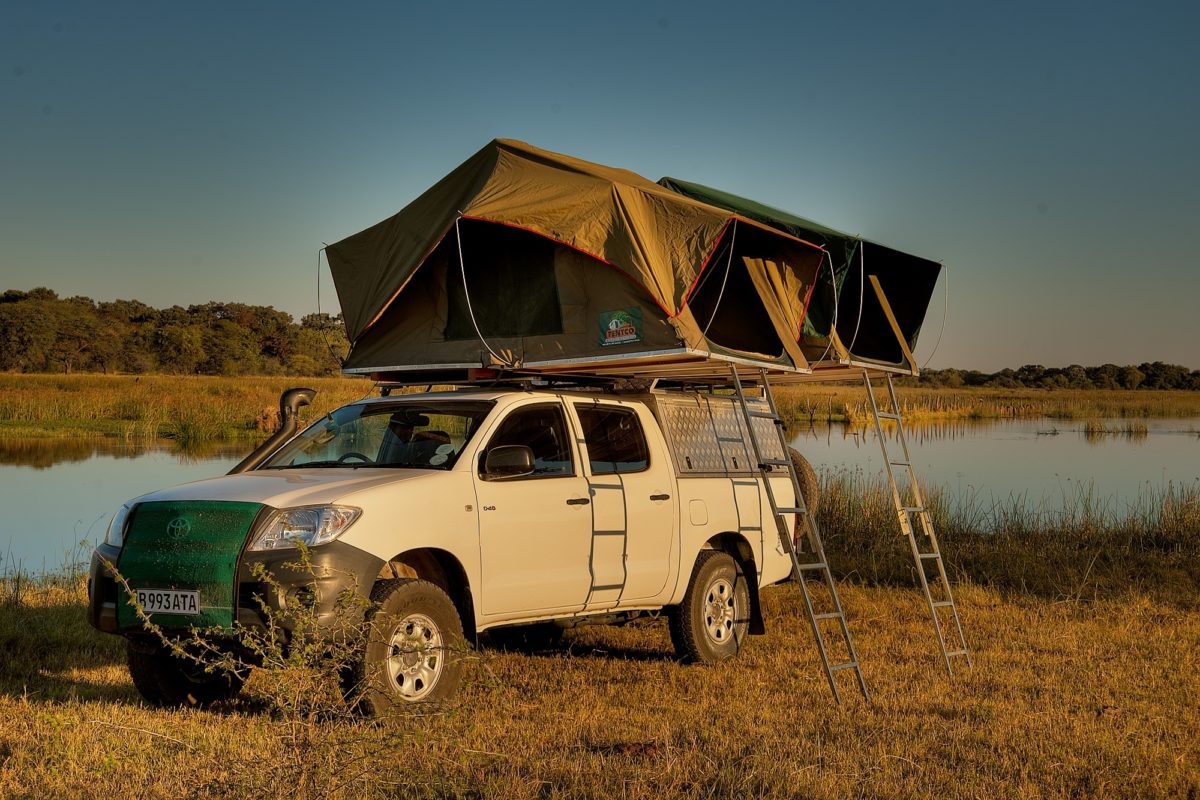
Travelers who want to minimize accommodation expenses can rent a vehicle equipped with a rooftop tent and camping equipment.
Current Uganda rental listings show rooftop-tent vehicles commonly costing around US$140–190 per day, although other operators advertise lower rates depending on the vehicle and equipment package.
At first, that can seem expensive compared with a basic RAV4.
But the rooftop-tent vehicle gives you accommodation equipment as part of the setup, allowing you to use campsites rather than paying lodge rates every night.
The calculation therefore needs to consider vehicle + camping equipment + campsite against vehicle + lodge.
Camping isn’t automatically cheaper in every situation.
If you rent a premium Land Cruiser with a rooftop tent, add camping equipment and then pay for higher-end campsites, you may find that the savings compared with a modest lodge are smaller than expected.
For adventurous travelers, however, camping provides something money cannot easily buy.
It puts you closer to the wilderness.
Waking up in a campsite near a national park and hearing birds calling before sunrise can become one of the most memorable parts of the safari.
What Does Camping Equipment Cost?
Camping equipment varies between rental companies.
Some provide a complete package containing a rooftop tent, mattress, sleeping bags, chairs, tables and cooking equipment.
Others charge separately for individual items.
For example, one current Uganda rental provider lists camping gear at approximately US$5 per day, while another 2026 guide estimates rooftop-tent rental at around US$15–25 per night, depending on the arrangement.
This variation is exactly why travelers should ask for a complete equipment list before booking.
You don’t want to arrive expecting a fully equipped camping vehicle and discover that you still need to rent cooking equipment, sleeping bags or other essentials.
Ask the rental company to provide the equipment list in writing.
National Park Fees for Self-Drive Travelers
National park fees are another major part of the calculation.
For self-drive travelers, there are usually two separate considerations.
First, there is the individual park entrance fee.
Second, there can be a vehicle entry fee.
Under the UWA conservation tariff covering July 2024 to June 2026, foreign-registered tour-company vehicles and 4-wheel drives are listed at, while saloon cars are listed at US$40 and minibuses at US$50. The tariff also specifies an additional US$10 vehicle entrance charge for Murchison Falls National Park for foreign-registered vehicles.
Because that published tariff runs through June 2026, travelers planning a safari after that period should verify the applicable UWA tariff for their travel dates rather than automatically using the old figure.
This is particularly important for a self-drive safari because you are responsible for understanding the applicable charges.
You should also remember that park fees are not the same thing as activity fees.
A boat cruise, chimpanzee trek or gorilla trek can have its own separate cost.
Self-Drive in Murchison Falls National Park
Murchison Falls can be an exciting destination for self-drive travelers because the park provides extensive opportunities for wildlife viewing.
However, the experience requires preparation.
You need to understand the park’s tracks, carry sufficient fuel and water and allow enough time to navigate between different areas.
The benefit of self-driving here is flexibility.
You can decide how long you want to spend at a particular wildlife sighting, provided you remain within park regulations.
But there is an important difference between being able to drive yourself and having an experienced safari guide.
A guide knows where wildlife is frequently found, recognizes animal tracks and calls and can often position the vehicle more effectively.
A self-drive traveler has to develop those skills independently.
That doesn’t make self-drive worse.
It simply makes it a different experience.
For someone who enjoys exploration and wants to learn, that independence can be exactly what makes the safari exciting.
Self-Drive in Queen Elizabeth National Park
Queen Elizabeth is another popular destination for independent travelers.
The park’s combination of savannah, wetlands, crater landscapes and the Kazinga Channel creates plenty of opportunities for exploration.
A self-drive itinerary here can include game drives followed by the famous Kazinga Channel boat cruise.
The major advantage is flexibility.
You can organize your accommodation and activities around your own schedule rather than following a fixed group itinerary.
However, travelers should remember that the park is large.
Navigation and route planning matter.
A GPS or reliable navigation system can be extremely useful, but technology should not be your only plan.
Download offline maps before entering remote areas and keep your rental company’s emergency contact information available.
Self-Drive in Bwindi
Bwindi is a completely different environment.
The roads around the forest can be steep and winding, and some approaches to the trekking sectors involve challenging terrain.
A proper 4×4 is therefore particularly important.
More importantly, gorilla trekking itself is not self-drive.
You can drive yourself to Bwindi and manage your own journey, but the actual gorilla trekking experience must follow the authorized trekking system with guides and trackers.
This distinction is important when explaining self-drive gorilla safaris to potential clients.
You are independently handling the transportation component.
The wildlife activity itself remains professionally managed
Is Kidepo Suitable for Self-Drive?
Kidepo is possible for experienced self-drive travelers, but it is not the destination where you want to underestimate preparation.
Its remote location means that assistance can take longer to reach you if something goes wrong.
The vehicle therefore matters considerably.
You need to think about spare tires, recovery equipment, fuel, water and communication.
This is also where having a reliable rental company becomes particularly important.
A vehicle that works perfectly around Kampala isn’t necessarily enough for a remote safari route.
Before booking, tell the rental company exactly where you intend to travel.
A good operator can advise you on the appropriate vehicle and equipment rather than simply handing you the cheapest available car.
Self-Drive vs Driver-Guide: Is the Saving Worth It?
This is probably the biggest question travelers ask.
At first glance, self-drive looks significantly cheaper because you don’t have to pay for a driver-guide.
Current 2026 market guides commonly put the driver addition around US$25–35 per day, although actual rates vary between rental companies and vehicle categories.
So if you’re traveling for ten days, you could potentially save several hundred dollars by driving yourself.
But you’re also taking responsibility for everything.
You navigate.
You drive.
You deal with traffic.
You manage the vehicle.
You handle directions.
You deal with unexpected problems.
And you don’t have a local wildlife expert sitting beside you.
For an experienced traveler who enjoys driving, that trade-off may be completely worthwhile.
For someone visiting Uganda for the first time and primarily interested in wildlife, the driver-guide can provide substantial value.
A guide doesn’t only drive.
They understand the parks.
They know how to interpret animal behavior.
They can help identify birds and wildlife.
They understand local roads.
They can also take responsibility for many of the practical details that would otherwise fall on you.
So the decision shouldn’t be based only on the daily driver fee.
It should be based on the type of experience you want.
Realistic Budgets, Planning Your Journey & What to Expect
Once you understand the cost of the vehicle, fuel, accommodation, park fees and activities, you can begin building a self-drive Uganda safari around your own budget. This is one of the biggest advantages of traveling independently because you are not locked into one fixed package. You can decide whether you want to keep things simple with a basic 4×4 and comfortable budget accommodation, or spend more on a well-equipped safari vehicle and higher-end lodges.
The final price will always depend on how you design the trip. A three-day safari close to Kampala will obviously cost less than a ten-day journey covering several national parks. Likewise, camping can reduce accommodation expenses, while luxury lodges can significantly increase the overall cost. The important thing is to look at the safari as a complete journey rather than judging it by the daily vehicle rental price alone.
How Much Does a 3-Day Self-Drive Uganda Safari Cost?
A three-day self-drive safari is ideal for travelers who have limited time but still want to experience Uganda’s wildlife and scenery. For a couple using a basic 4×4 at around US$45–70 per day, the vehicle could cost approximately US$135–210 for three days.
After adding fuel, accommodation, meals, park fees and activities, a practical budget for two people could be around US$500–1,000, depending on the destination and level of accommodation.
For a short safari, choosing the right destination is extremely important. You don’t want to spend one of your three days traveling hundreds of kilometers simply to reach a park. Destinations such as Lake Mburo can work well because they allow travelers to experience wildlife without committing to an extremely long road journey.
A short safari should feel like a getaway, not a race against the clock.
How Much Does a 5-Day Self-Drive Uganda Safari Cost?
Five days gives you more flexibility and allows you to explore a destination at a more relaxed pace. For two travelers, a reasonable planning budget could be approximately US$900–1,600, depending on the vehicle, accommodation, fuel, activities and park fees.
This duration works well for travelers who want to concentrate on one region rather than trying to see everything Uganda has to offer.
You could explore Queen Elizabeth National Park with game drives and a Kazinga Channel boat cruise, or focus on Kibale and combine chimpanzee trekking with another wildlife destination.
The beauty of five days is that you have enough time to enjoy the experience rather than constantly worrying about the next destination.
How Much Does a 7-Day Self-Drive Uganda Safari Cost?
Seven days provides a much better opportunity to experience several sides of Uganda.
For two travelers, you could plan around US$1,500–3,000+, depending on your accommodation, vehicle, fuel requirements and activities.
A budget-conscious traveler might choose camping and a basic 4×4, while another traveler may choose comfortable safari lodges and a more capable Land Cruiser.
A seven-day itinerary could potentially combine destinations such as Kibale, Queen Elizabeth and Bwindi, giving travelers the chance to experience chimpanzees, savannah wildlife and mountain gorillas during the same journey.
However, adding more destinations should never be the main objective.
The best safari is not necessarily the one with the longest itinerary.
It is the one that gives you enough time to appreciate where you are.
How Much Does a 10-Day Self-Drive Uganda Safari Cost?
Ten days gives you considerably more freedom to explore Uganda.
For two travelers, a realistic planning range could be around US$2,000–4,000+, depending on the route, vehicle, accommodation and activities.
At this length, fuel becomes a particularly important part of the calculation. You may cover hundreds or thousands of kilometers depending on the destinations you choose.
Vehicle reliability also becomes increasingly important.
A small saving on the daily rental rate is not worthwhile if the vehicle is unsuitable for the roads you plan to travel.
Travelers should ask about roadside assistance, spare tires, insurance, mileage restrictions and recovery support before confirming their rental.
A longer safari can also use domestic flights strategically. Instead of driving every long-distance section, you could combine self-drive with a flight and save valuable time.
Self-Drive Uganda Safari Cost for Couples
For couples, self-drive can be an attractive option because the vehicle cost is shared between two travelers.
A US$60-per-day vehicle, for example, represents approximately US$30 per person per day before fuel and other expenses.
But the financial advantage is only part of the experience.
Couples also get the freedom to decide how they want their safari to feel.
You can leave your lodge early for a sunrise game drive, stop whenever you want to take photographs or spend longer at a particular wildlife sighting.
The only thing couples should consider carefully is the driving itself.
If only one person is comfortable driving long distances, a very ambitious itinerary can quickly become exhausting.
A relaxed route is often a much better choice.
Self-Drive Uganda Safari Cost for Families
Families need to think about comfort as much as cost.
The vehicle needs to provide enough room for passengers and luggage, and younger children may find very long journeys tiring.
A larger 4×4 can therefore make sense even if it costs slightly more.
Families should also avoid packing too many destinations into a short trip.
Having fewer destinations with comfortable travel days can make the safari much more enjoyable for everyone.
For some families, hiring a driver-guide may ultimately provide better value because the adults can relax while someone else handles the road and navigation.
For families who already enjoy road trips, however, self-drive can turn the entire journey into part of the adventure.
Is Self-Drive Uganda Cheaper Than a Guided Safari?
Self-drive can be cheaper because you don’t have to pay for a dedicated driver-guide.
Current Uganda rental information commonly places driver-guide charges around US$25–35 per day, although actual rates vary between companies and rental arrangements.
However, travelers should not look at the driver cost alone.
A professional safari guide provides local knowledge, wildlife expertise, navigation and logistical support.
They may know where wildlife is commonly found and how to interpret animal behavior.
With self-drive, you take responsibility for all of this yourself.
For an experienced independent traveler, that responsibility can actually be part of the fun.
For someone who simply wants to relax and concentrate on wildlife, a guided safari may be worth the additional cost.
Choosing the Right 4×4 for Your Safari
A Toyota RAV4 or similar 4×4 can work well for travelers following relatively straightforward routes.
A Toyota Prado offers more space and capability for longer journeys.
A Land Cruiser safari vehicle is particularly useful for travelers planning extensive national-park travel or camping.
Current rental listings commonly advertise RAV4s around US$50–65 per day, while Prado and Land Cruiser options can be considerably more expensive.
The cheapest vehicle isn’t necessarily the best vehicle.
The correct choice depends on your route, the number of passengers, luggage, camping equipment and the terrain you expect to encounter.
What to Check Before Renting a Self-Drive Vehicle
Before accepting the vehicle, take photographs and videos of its condition.
Check the bodywork, windows, tires, spare tire, jack and tools.
Confirm the insurance arrangement and understand the excess.
Ask what happens if the vehicle breaks down in a remote location.
It is also worth checking whether tires, windscreen damage and underbody damage are covered.
Mileage restrictions should also be clarified.
A vehicle with unlimited mileage can provide considerably better value for travelers planning long-distance safaris.
Navigation and Communication
A reliable navigation system is essential for independent travel.
Download offline maps before leaving areas with strong internet coverage and save your accommodation locations in advance.
Keep your rental company’s emergency contact details accessible.
Do not rely completely on mobile data because coverage can become unreliable in remote areas.
Good preparation doesn’t take away the sense of adventure.
It simply means that when you encounter the unexpected, you are better prepared to deal with it.
Can You Drive at Night on a Uganda Safari?
Night driving on unfamiliar roads should be approached carefully.
Visibility is reduced, and pedestrians, motorcycles, animals, potholes and poorly lit vehicles can become difficult to see.
For most safari itineraries, it is better to plan your daily route so that you arrive at your accommodation before darkness.
Inside national parks, you must also follow the relevant park regulations governing vehicle movements and activities.
A comfortable safari itinerary should never require you to drive for hours at night simply to stay on schedule.
Common Self-Drive Mistakes to Avoid
One of the biggest mistakes is trying to cover too much ground.
Uganda may not look enormous on a map, but road conditions, traffic and terrain can make journeys considerably longer than expected.
Another mistake is choosing a vehicle purely because it has the lowest daily rate.
Travelers should also avoid underestimating fuel costs and forgetting to include park fees, vehicle charges and activities.
But perhaps the biggest mistake is treating the safari like a timetable.
Self-drive is supposed to give you freedom.
If you find an incredible viewpoint, stop.
If elephants appear beside the road where stopping is permitted, enjoy the moment.
If you want to spend another hour exploring an area, allow yourself that freedom.
Those unscheduled moments can become the stories you remember for years.
Frequently Asked Questions About Self-Drive Uganda Safari Cost
How much does a self-drive Uganda safari cost?
For 2026 planning, a couple could budget approximately US$500–1,000 for three days, US$900–1,600 for five days, US$1,500–3,000+ for seven days, and approximately US$2,000–4,000+ for ten days, depending on the vehicle, accommodation, fuel, park fees and activities.
How much does it cost to rent a 4×4 in Uganda?
Basic 4x4s such as RAV4s can commonly cost around US$40–70 per day, while Prado and Land Cruiser options can range from approximately US$60–175+ per day, depending on the rental company and vehicle.
Do I need a 4×4 for a Uganda safari?
For serious national-park travel, a 4×4 is strongly recommended because safari tracks can become rough and muddy, particularly during rainy periods.
Can I self-drive to Bwindi?
Yes. You can drive yourself to the Bwindi region, but gorilla trekking itself is conducted through the authorized trekking system with guides and trackers.
Can I self-drive in Murchison Falls?
Yes. Self-drive travelers can explore Murchison Falls provided they follow park regulations and use a suitable vehicle.
Can I self-drive to Kidepo Valley?
Yes, but Kidepo requires additional preparation because of its remote location. A reliable 4×4, sufficient fuel, spare tires and emergency planning are especially important.
Is camping cheaper than staying in lodges?
It can be, although it depends on the cost of the camping vehicle, equipment, campsite and other expenses compared with lodge accommodation.
Is self-drive safe in Uganda?
Many travelers successfully explore Uganda by self-drive, but careful planning, responsible driving and proper preparation are essential, particularly in remote areas.
Can I rent a car without a driver in Uganda?
Yes. Several rental companies offer self-drive 4x4s, although insurance conditions and rental requirements vary.
Is self-drive better than a guided safari?
It depends on your priorities. Self-drive offers independence and can reduce transportation costs, while guided safaris provide local expertise and make the journey easier.
Don’t Just Visit Uganda—Experience the Road Between the Destinations
A self-drive Uganda safari is for the traveler who wants more than simply arriving at a destination and checking it off a list. It is about waking up knowing the road ahead is yours to discover, watching Uganda’s landscapes change through the windscreen and finding those unforgettable moments along the way. With the right vehicle, a sensible budget and enough time, you can turn a simple road trip into a genuine African adventure. From the first stretch of highway to the moment you find yourself watching elephants, lions or Uganda’s beautiful landscapes, every kilometer becomes part of your story. So fuel the vehicle, pack your bags, choose your route and let Uganda surprise you—because the best safari memories are often the ones you never planned for.