









Olive Baboon: Facts, Habitat, Behavior & Where to See Them on Safari
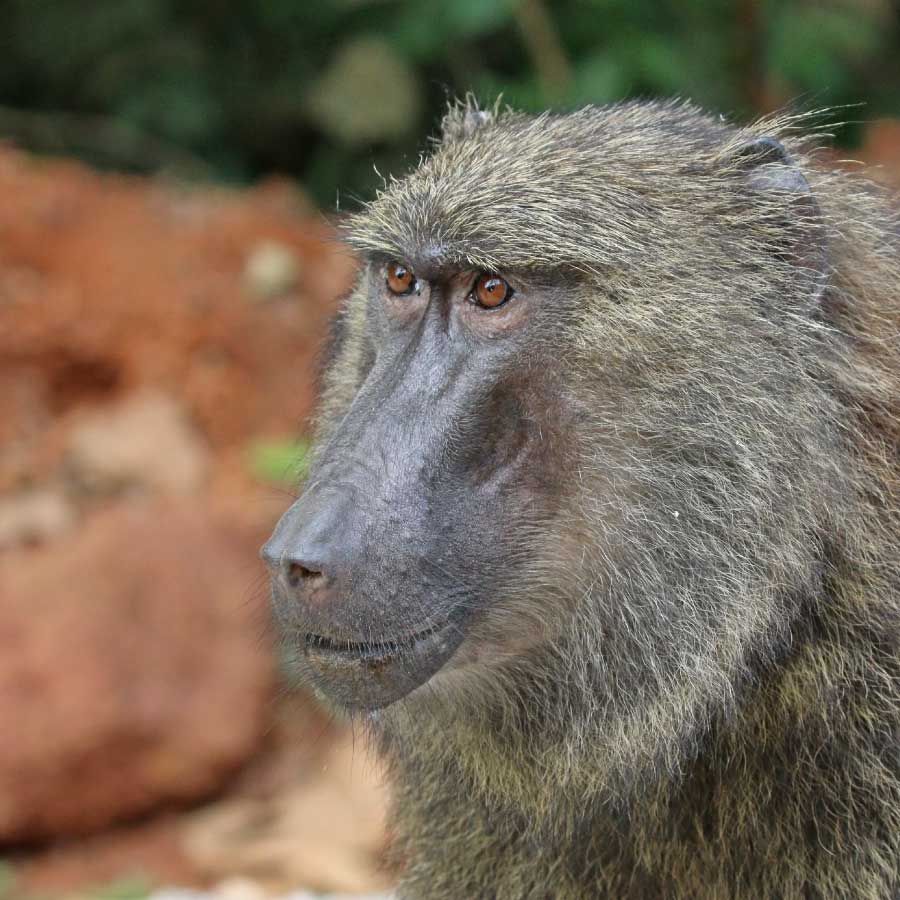
The olive baboon (Papio anubis) is one of Africa’s most widespread and adaptable primates. Recognized by its olive-brown coat, long muzzle, powerful build and expressive face, this highly social monkey can be found across a remarkable range of habitats, from open savannahs and woodlands to forests and areas close to human settlements.
Although olive baboons may not receive the same attention as mountain gorillas, chimpanzees or lions, they are among the most interesting primates to encounter on an African safari. Their large troops are constantly active, with individuals feeding, grooming, communicating, playing and keeping watch for potential threats.
For travelers exploring Uganda, Kenya or Tanzania, olive baboons can be encountered in many protected wildlife areas. They are particularly easy to notice in savannah environments, where their social behavior can provide fascinating wildlife-viewing opportunities.
Understanding their behavior also helps visitors appreciate that seeing a baboon troop isn’t simply another roadside sighting. Behind those seemingly ordinary moments is a complex social world involving family relationships, dominance hierarchies, communication and cooperation.
Quick Facts About the Olive Baboon
| Common name | Olive baboon |
|---|---|
| Scientific name | Papio anubis |
| Animal group | Old World monkey |
| Family | Cercopithecidae |
| Diet | Omnivorous |
| Habitat | Savannah, woodland, forest and semi-arid areas |
| Distribution | Much of sub-Saharan Africa |
| Social structure | Large troops |
| Main food | Fruits, seeds, grasses, roots, leaves and insects, with occasional animal prey |
| Conservation status | Least Concern |
| Major threats | Habitat loss, conflict with humans and persecution in some areas |
What Does an Olive Baboon Look Like?
The olive baboon gets its name from the characteristic olive-greenish or olive-brown appearance of its coat.
Their fur can look different depending on lighting and age, but the overall coloration provides useful camouflage within African grasslands and woodland.
They have long faces with prominent muzzles, relatively large canine teeth and powerful jaws.
Their limbs are strong, allowing them to walk efficiently on the ground while also climbing trees when necessary.
Males are considerably larger than females and usually have larger canine teeth.
One of the most noticeable features of adult males is their impressive physical build.
Females are smaller but remain highly capable animals and play important roles within the troop, particularly in raising young and maintaining social relationships.
Young baboons are often much more playful and curious than adults and can frequently be seen climbing, chasing one another or staying close to their mothers.
Where Do Olive Baboons Live?
Olive baboons have one of the broadest distributions of any baboon species.
They occur across large parts of East, Central and West Africa, making them a relatively common sighting on many African safaris.
They are highly adaptable and can occupy:
- Open savannah
- Grasslands
- Woodland
- Forest edges
- Riverine environments
- Semi-arid areas
- Mountain slopes
- Agricultural landscapes
Their adaptability is one of the reasons they have remained widespread even as human development has changed parts of their natural habitat.
In East Africa, travelers can encounter olive baboons in a number of famous safari destinations.
In Uganda, they can be seen in several national parks and protected areas, including Queen Elizabeth National Park, Murchison Falls National Park, Kidepo Valley National Park and Lake Mburo National Park.
In Kenya and Tanzania, they also occur across numerous wildlife areas.
What Do Olive Baboons Eat?
Olive baboons are omnivores, which means they have a highly flexible diet.
They eat a wide variety of foods, including:
- Fruits
- Seeds
- Leaves
- Grass
- Roots
- Tubers
- Flowers
- Insects
- Eggs
- Small animals
- Occasionally other available animal foods
This dietary flexibility is one of their greatest survival advantages.
When fruits are abundant, baboons can take advantage of them.
When fruit becomes scarce, they can switch to grasses, seeds, roots or other available foods.
They frequently forage on the ground, using their hands to search through vegetation and soil.
A troop may spread out while feeding, allowing individuals to search a relatively large area.
This constant movement means that a safari traveler may see baboons feeding along a road, crossing open grassland or moving between trees.
Olive Baboon Social Life
The social structure of olive baboons is one of the most fascinating things about the species.
They live in large troops that can contain many individuals.
A troop normally includes:
- Adult males
- Adult females
- Juveniles
- Infants
The group provides protection, companionship and opportunities for social interaction.
Baboons spend significant amounts of time grooming each other.
Grooming isn’t simply about removing dirt or parasites.
It also strengthens social bonds.
Individuals that have strong relationships may spend more time together and support one another during social conflicts.
This makes baboon society surprisingly complicated.
A troop may appear chaotic from a distance, but individual animals know one another and maintain relationships that influence how the group functions.
Dominance and Hierarchy
Olive baboon troops have social hierarchies.
Dominance can influence access to food, mating opportunities and social interactions.
Adult males can compete with one another for status, while females also have their own social relationships and hierarchies.
However, dominance isn’t simply about physical strength.
Relationships and alliances can influence social outcomes.
This is one of the reasons baboons are so interesting to researchers studying primate behavior.
A traveler watching a troop for several minutes may notice grooming, play, aggression, reconciliation and other interactions happening almost simultaneously.
Communication Among Olive Baboons
Olive baboons have an impressive communication system.
They use vocalizations, facial expressions, body movements and physical contact to communicate with one another.
Different calls can communicate information about:
- Predators
- Food
- Separation from the troop
- Aggression
- Social interactions
- Potential danger
If a baboon detects a predator, it may produce an alarm call that alerts others.
The rest of the troop can respond quickly.
This is particularly important because baboons have several predators, including lions, leopards, hyenas and large birds of prey that may target younger individuals.
Their ability to communicate therefore has real survival value.
How Olive Baboons Protect Themselves
Living in a large troop provides an important defensive advantage.
There are many eyes watching the surroundings, increasing the likelihood that someone will detect danger early.
When a predator approaches, adults may become alert while younger animals move closer to protection.
Adult males can play an important defensive role because of their size and strength.
Baboons can also climb trees when necessary, giving them additional escape options.
However, they are not invulnerable.
Young baboons are particularly vulnerable to predators, and predators may attempt to isolate individuals from the troop.
This is why group living is so important.
Reproduction and Young Baboons
Female olive baboons form strong relationships with their offspring.
Young baboons remain close to their mothers during their early development.
Infants are carried by their mothers and gradually become more independent as they grow.
As they become juveniles, they spend increasing amounts of time playing with other young baboons.
Play is important because it allows youngsters to develop physical coordination and learn social behavior.
Young baboons may wrestle, chase each other, climb trees and experiment with objects.
These seemingly playful activities help them develop the skills needed for adult life.
Predators of Olive Baboons
Olive baboons are prey for several African predators.
Potential predators include:
- Lions
- Leopards
- Spotted hyenas
- African wild dogs in some areas
- Large birds of prey, particularly for young baboons
- Crocodiles around water
Their response to predators depends on the situation.
A leopard approaching through woodland may trigger an alarm response, while a lion entering open grassland can cause the troop to move toward safer terrain or trees.
Baboons are capable of defending themselves, particularly when several adults respond together.
Olive Baboons and Leopards
The relationship between olive baboons and leopards can be particularly interesting on safari.
Leopards are skilled climbers and can hunt baboons in areas where the two species overlap.
Baboons are therefore constantly alert to leopard presence.
A troop may suddenly become extremely vocal when a leopard is detected.
For a safari guide, this behavior can sometimes provide useful clues about predator activity.
A seemingly noisy baboon troop may actually be responding to something that visitors haven’t yet noticed.
Olive Baboons and Human Communities
Olive baboons are highly adaptable, which can sometimes bring them into conflict with people.
Where agricultural land borders natural habitat, baboons may enter farms looking for crops.
Their intelligence and adaptability can make them difficult to deter.
This can create challenges for farmers and conservation authorities.
Responsible conservation therefore needs to consider both wildlife protection and the needs of people living near wildlife areas.
Maintaining protected habitats and reducing conflict are important for ensuring that baboon populations can coexist with surrounding communities.
Are Olive Baboons Dangerous?
Olive baboons are wild animals and should never be treated like domestic monkeys.
They have powerful jaws and large canine teeth, particularly adult males.
Problems can occur when people feed baboons or encourage them to associate humans with food.
This can cause animals to become aggressive or dependent on human food.
Safari visitors should therefore never attempt to feed or touch baboons.
If you encounter them near a lodge, campsite or safari vehicle, allow them to behave naturally and follow the instructions of your guide.
Olive Baboons on Safari
One of the best things about seeing olive baboons is that they are often active during the day.
A safari vehicle may encounter a troop crossing the road, feeding in grassland or resting beneath trees.
Unlike a solitary animal that may disappear quickly, a troop can provide an extended wildlife-viewing opportunity.
You might see:
- Mothers carrying infants
- Youngsters playing
- Adults grooming
- Individuals feeding
- Males displaying
- Troops crossing roads
- Baboons communicating through calls
Because there can be so much activity, baboons can make surprisingly entertaining safari subjects.
Where to See Olive Baboons in Uganda
Queen Elizabeth National Park
Queen Elizabeth National Park provides excellent opportunities to encounter a wide range of primates alongside classic savannah wildlife.
Olive baboons can be seen in suitable habitats as they move between woodland and open areas.
Murchison Falls National Park
Murchison Falls offers extensive savannah and woodland habitats where olive baboons can be encountered during game drives.
The combination of primates and larger mammals makes it one of Uganda’s most diverse safari destinations.
Kidepo Valley National Park
Kidepo’s rugged landscapes and extensive savannahs provide opportunities to observe olive baboons among the park’s distinctive wildlife.
Lake Mburo National Park
Lake Mburo is another destination where travelers may encounter olive baboons alongside zebras, impalas, buffaloes and other wildlife.
Where Else Can You See Olive Baboons?
Olive baboons are not limited to Uganda.
Travelers may also encounter them in several safari destinations across Kenya and Tanzania.
This includes areas of the Maasai Mara ecosystem, Serengeti ecosystem and other protected landscapes where suitable habitat exists.
This widespread distribution makes the olive baboon one of the primates most likely to appear during a general East African safari.
Unlike species with extremely restricted ranges, you don’t normally need to organize an entire safari specifically around finding olive baboons.
They are more often a fascinating part of the broader wildlife experience.
Best Time to See Olive Baboons
Because olive baboons live in a variety of habitats and remain active throughout the year, they can generally be seen during safari trips in different seasons.
The best time for an individual safari depends more on the destination and the other wildlife you want to see.
During game drives, early mornings and late afternoons are particularly productive because wildlife is often more active during the cooler parts of the day.
However, olive baboons can remain active during much of the daylight period.
Photography Tips for Olive Baboons
Baboons are excellent photographic subjects because of their expressive faces and constantly changing behavior.
Instead of photographing only individual animals, try capturing interactions.
Good moments can include:
- Grooming
- Mothers with infants
- Juveniles playing
- Alarm calls
- Troops crossing roads
- Adult males displaying
A medium telephoto lens is useful because it allows you to photograph animals without getting unnecessarily close.
Most importantly, never attempt to attract a baboon’s attention simply to improve a photograph.
Interesting Facts About Olive Baboons
They are highly adaptable.
Olive baboons can survive across an impressive variety of habitats.
They are excellent foragers.
Their flexible diet allows them to exploit many different food sources.
They have complex societies.
Their troops contain intricate relationships and hierarchies.
They communicate extensively.
Vocalizations and body language are essential to their daily lives.
They are excellent climbers.
Although they spend substantial time on the ground, trees provide food, shelter and escape opportunities.
They are intelligent.
Their ability to learn and adapt helps them exploit changing environments.