



Blue Monkey: Facts, Habitat, Behavior & Where to See Them in Uganda
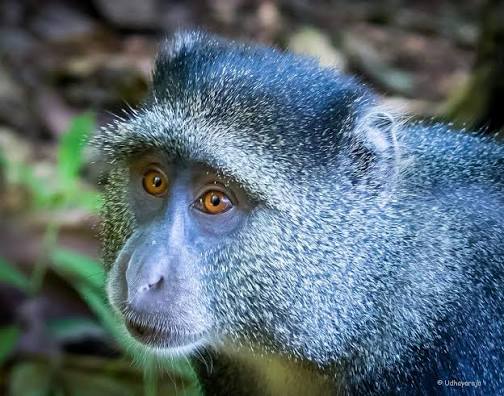
The blue monkey (Cercopithecus mitis) is a fascinating forest-dwelling primate found across parts of eastern and central Africa. Despite its name, this monkey isn’t actually bright blue. Its coat is usually a mixture of gray, olive and bluish tones, while its face often has distinctive dark features and pale markings.
Blue monkeys are particularly interesting because they spend much of their lives in forest environments, where their agile movements, social behavior and quiet feeding habits can make them more challenging to spot than some of Uganda’s larger primates.
For travelers exploring Uganda, encountering a blue monkey can be a rewarding part of a forest or primate safari. They can be found in several forested habitats, including areas associated with Kibale National Park, Bwindi and other protected forests.
Unlike mountain gorillas, which have become accustomed to carefully regulated human observation in specific groups, many blue monkeys encountered in the wild are not the primary focus of a trekking experience. Instead, they are often discovered while exploring the forest alongside guides who understand their calls, movements and preferred habitats.
Understanding the blue monkey therefore adds another layer to the story of Uganda’s extraordinary primate diversity.
Quick Facts About the Blue Monkey
| Common name | Blue monkey |
|---|---|
| Scientific name | Cercopithecus mitis |
| Animal group | Old World monkey |
| Family | Cercopithecidae |
| Diet | Primarily fruits and leaves, supplemented with other foods |
| Habitat | Tropical and montane forests |
| Distribution | Eastern and central Africa |
| Social structure | Social groups, often centered around females |
| Main threats | Habitat loss, fragmentation and hunting in some areas |
| Conservation status | Varies by population/subspecies; the species complex includes populations facing different conservation pressures |
What Does a Blue Monkey Look Like?
The name blue monkey can be misleading.
You shouldn’t expect to see a monkey with bright blue fur.
Instead, its coat usually has a subtle blue-gray, olive or grayish appearance, especially when sunlight catches the individual hairs.
The face is generally dark, with pale or whitish markings around parts of the eyes and mouth that can create a distinctive expression.
Blue monkeys have relatively long limbs and tails, adaptations that help them navigate forest canopies.
Their bodies are relatively slender compared with baboons, making them agile climbers.
Males are generally larger than females.
Young blue monkeys tend to remain close to their mothers during their early development and gradually become more independent as they grow.
The combination of a darker face, grayish coat and forest-adapted body makes them recognizable to experienced guides, although identifying particular populations can be more complicated because the blue monkey belongs to a taxonomically complex group.
Why Is It Called a Blue Monkey?
The name comes from the subtle bluish or blue-gray appearance of its coat.
The coloration is usually caused by the combination of dark hairs and the way light interacts with the fur rather than a vivid blue pigment.
In the shaded environment of a tropical forest, this coloration can blend surprisingly well with branches, leaves and shadows.
That camouflage can make blue monkeys difficult to spot.
A guide may point toward a section of canopy and tell you there is a monkey sitting there, yet you may initially see nothing.
Then the animal moves.
Suddenly, you realize it was watching you from the branches all along.
Where Do Blue Monkeys Live?
Blue monkeys are associated primarily with forest habitats across parts of eastern and central Africa.
They can occupy:
- Tropical rainforests
- Montane forests
- Evergreen forests
- Forest edges
- Secondary forest
- Woodland environments
They are particularly dependent on trees because much of their daily activity involves feeding and moving through the forest canopy.
In Uganda, blue monkeys occur in several forested landscapes.
They may be encountered in and around important primate areas including Kibale National Park, Bwindi and other forest habitats.
This makes them particularly relevant to travelers interested in Uganda’s wider primate diversity.
Blue Monkeys in Uganda
Uganda is famous for its concentration of primates.
The country is home to mountain gorillas, chimpanzees, golden monkeys, red-tailed monkeys, black-and-white colobus monkeys, vervet monkeys and several other species.
Blue monkeys form part of this remarkable primate community.
Kibale National Park
Kibale is best known internationally for chimpanzee trekking, but its forest ecosystem supports a much wider range of primates.
Blue monkeys can be among the species encountered while exploring the park.
Bwindi Impenetrable National Park
Bwindi’s dense forest is best known for mountain gorillas, but it also supports a range of other forest wildlife.
Blue monkeys and other primates contribute to the park’s remarkable biodiversity.
Other Forest Habitats
Blue monkeys can also occur in other suitable forest environments across Uganda.
Their distribution means that travelers interested in forest primates may encounter them while exploring areas beyond Uganda’s most famous trekking destinations.
What Do Blue Monkeys Eat?
Blue monkeys are primarily herbivorous, although their diet can include a range of additional foods.
They feed on:
- Fruits
- Leaves
- Flowers
- Seeds
- Young shoots
- Buds
- Insects and other small animal foods when available
Fruit can be particularly important.
When fruiting trees are available, blue monkeys may spend considerable time feeding within the canopy.
Their ability to use different food sources allows them to adapt to seasonal changes in the forest.
They may move between different parts of their home range as food availability changes.
This means that their movements are closely connected to the ecology of the forest.
Blue Monkey Social Structure
Blue monkeys are social animals.
Groups typically contain several individuals, although the exact structure can vary.
Females play an important role in maintaining social groups, while males may move between groups as they mature.
Social relationships are maintained through:
- Grooming
- Vocal communication
- Physical contact
- Play
- Shared movement
- Mother-offspring relationships
Grooming is particularly important.
It helps maintain social bonds and can reduce tension between individuals.
A troop may therefore spend considerable time interacting even when there is no obvious activity such as feeding or moving.
Communication
Blue monkeys communicate through a combination of sounds, body movements and facial expressions.
Their calls may alert other individuals to danger, help maintain contact between group members or communicate during social interactions.
Because they live in dense forest, communication is particularly valuable.
A monkey may be hidden behind leaves or several meters away in the canopy.
Vocalizations allow individuals to remain connected even when visibility is limited.
For tourists, this means that listening carefully can be just as important as looking.
A guide may hear a call before identifying the animal visually.
How Do Blue Monkeys Move Through the Forest?
Blue monkeys are highly adapted to life in trees.
Their long limbs and tail help them maintain balance while moving through branches.
They can move quickly when necessary, particularly when escaping a predator.
They may also descend to lower levels of vegetation or the forest floor depending on food availability and environmental conditions.
Their movement can be difficult to follow because dense foliage often hides them.
A monkey may disappear behind a branch and reappear several meters away.
This is one reason forest primate viewing can feel very different from watching animals in an open savannah.
Reproduction and Young
Female blue monkeys give birth to young that require significant maternal care.
The mother provides food, protection and transportation during the early stages of the infant’s life.
Young monkeys initially remain extremely close to their mothers.
As they develop, they begin exploring their environment.
Juveniles may interact with other young members of the group through play.
These interactions help them learn important social and physical skills.
The relationship between mother and infant is therefore central to early survival.
Predators of Blue Monkeys
Blue monkeys face threats from a number of forest predators.
Potential predators include:
- Leopards
- Large snakes
- Birds of prey
- Other predators capable of accessing the forest canopy
Young monkeys are particularly vulnerable.
Their primary defense is early detection.
Living in groups provides multiple sets of eyes and ears to monitor the environment.
When danger is detected, individuals can alert others and move toward safer parts of the forest.
The canopy itself also provides important escape routes.
Blue Monkeys and the Forest Ecosystem
Blue monkeys aren’t simply inhabitants of the forest—they also play a role in its ecology.
By feeding on fruits and moving between trees, they can contribute to seed dispersal.
Seeds consumed with fruit can be transported away from the parent tree and eventually deposited elsewhere.
This can contribute to forest regeneration.
As a result, protecting blue monkeys also helps preserve the ecological relationships that connect animals and plants within tropical forests.
What Threatens Blue Monkeys?
The most important threats facing blue monkeys in many areas are associated with changes to their forest habitats.
Habitat loss
Clearing forests for agriculture, settlements and other development reduces available habitat.
Habitat fragmentation
Even when some forest remains, breaking it into isolated patches can make it more difficult for animals to move between populations.
Hunting
In some parts of their range, forest primates face pressure from hunting.
Human-wildlife conflict
When natural food sources become limited and forests are fragmented, wildlife can come into closer contact with people.
Conservation therefore depends heavily on protecting forest habitats and maintaining ecological connectivity.
Blue Monkey Conservation
Conservation of blue monkeys is closely linked to the conservation of their forest homes.
Protected areas such as Uganda’s national parks provide important refuges.
However, protecting individual forest patches isn’t always enough.
Maintaining connections between forests can help wildlife populations remain genetically and ecologically healthy.
Tourism can contribute indirectly to this effort by generating revenue for protected areas and creating economic opportunities connected to conservation.
Visitors also have a responsibility to minimize disturbance and follow wildlife-viewing guidelines.
What Is It Like to See a Blue Monkey on Safari?
A blue monkey encounter is usually quite different from a gorilla or chimpanzee encounter.
You may not have an entire trekking experience specifically dedicated to finding blue monkeys.
Instead, they can appear while exploring a forest ecosystem.
You might hear movement above you.
Your guide stops.
Everyone looks upward.
Then a blue monkey moves between branches.
For a few seconds it may sit still and provide a clear view.
Then it disappears into the foliage.
That unpredictability is part of the attraction.
Can You See Blue Monkeys During Chimpanzee Trekking?
Yes, potentially.
Kibale’s forests support multiple primate species, so a chimpanzee trekking experience can provide opportunities to observe other monkeys as well.
However, travelers should understand that chimpanzee trekking is specifically designed around finding habituated chimpanzee communities.
Seeing other primates is an added benefit rather than the primary objective.
Internal link: Chimpanzee Trekking in Uganda
Blue Monkey vs Vervet Monkey
Blue monkeys and vervet monkeys are both African Old World monkeys, but they are adapted to somewhat different environments.
Blue monkeys are strongly associated with forests and spend much of their time in trees.
Vervet monkeys are more adaptable to open woodland and savannah environments and are frequently encountered on conventional game drives.
Their appearance also differs.
Blue monkeys tend to have darker, more muted gray-blue coloring, while vervet monkeys have more distinctive facial characteristics and are commonly seen in open habitats.
Internal link: Vervet Monkey
Blue Monkey vs Olive Baboon
The differences become even more obvious when comparing blue monkeys with olive baboons.
Olive baboons are much larger and have powerful bodies adapted to spending considerable time on the ground.
Blue monkeys are smaller and more closely associated with forest canopy environments.
Baboons can often be seen crossing open savannah, while blue monkeys are more likely to disappear into woodland or forest vegetation.
Internal link: Olive Baboon
Best Time to See Blue Monkeys
Blue monkeys can be encountered throughout the year in suitable habitats.
However, visibility can be affected by:
- Rain
- Dense vegetation
- Seasonal fruit availability
- Animal movement
- Forest conditions
Dry periods may make some trails easier to navigate, while wetter periods can produce exceptionally lush forests.
Because blue monkeys are not usually the primary target of a safari, the best time to see them should be considered alongside the wider itinerary.
If your trip includes chimpanzees, gorillas and other wildlife, choose your travel season based on the complete experience rather than blue monkeys alone.
How Difficult Is It to See Blue Monkeys?
Finding blue monkeys can be more challenging than spotting larger animals in open habitats.
Their forest environment can hide them effectively.
You may hear them without seeing them.
You may see branches moving without identifying the animal.
And sometimes they may be visible only for a few seconds.
This is why an experienced guide can make a major difference.
Guides familiar with the forest can identify calls, movement patterns and likely feeding areas.
Photography Tips
Photographing blue monkeys in dense forest can be challenging because lighting is often limited.
A camera with good low-light performance can help.
A telephoto lens is also useful because you may be viewing animals high in the canopy.
Instead of trying to get a perfect portrait every time, look for behavior.
Good opportunities include:
- Feeding
- Grooming
- Mothers carrying infants
- Juveniles playing
- Movement between branches
- Group interactions
Be patient.
The monkey may disappear behind vegetation and reappear moments later.
Responsible Blue Monkey Viewing
Even though blue monkeys are smaller than gorillas and elephants, they deserve the same respect.
Visitors should:
- Avoid approaching them
- Never feed them
- Avoid making noises to attract them
- Follow guide instructions
- Keep appropriate distances
- Never attempt to touch them
- Avoid leaving food or rubbish behind
Responsible wildlife viewing ensures that animals retain their natural behavior.
Interesting Facts About Blue Monkeys
They aren’t actually bright blue.
Their name comes from the subtle blue-gray appearance of their coat.
They are forest specialists.
Much of their lives are spent in tree-rich habitats.
They are social.
Groups maintain complex relationships through grooming and communication.
They help forests regenerate.
Their feeding behavior can contribute to seed dispersal.
They are agile climbers.
Their limbs and tails are adapted for movement through the canopy.
They are difficult to spot.
Their forest coloration and dense habitat can make them surprisingly elusive.
They are part of Uganda’s rich primate diversity.
Seeing one adds another species to an already impressive forest wildlife experience.