



De Brazza’s Monkey
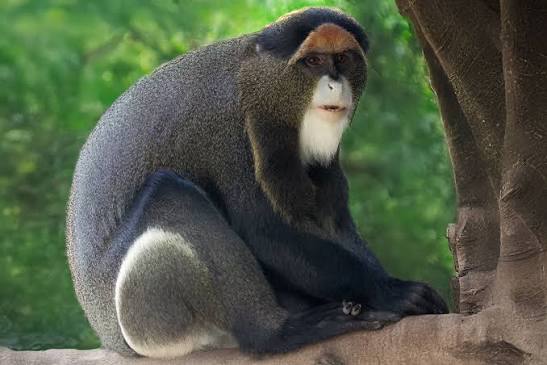
The De Brazza’s monkey (Cercopithecus neglectus) is one of Africa’s most distinctive forest monkeys. Sometimes called the swamp monkey, it is famous for its unusual facial appearance: a reddish-brown forehead, white beard, dark face and pale body markings create a look that makes it surprisingly easy to recognize.
Unlike some of Uganda’s more famous primates, De Brazza’s monkeys are generally quiet and secretive. They often remain hidden among dense vegetation, particularly around forests, rivers and wetlands.
This makes encountering one in the wild a special experience.
You might see a flash of grey fur between branches, notice a white beard beneath a dark face, and suddenly realize that you’ve found one of Africa’s most unusual-looking monkeys.
For travelers exploring Uganda, the species adds another layer to the country’s remarkable primate diversity.
Quick Facts About De Brazza’s Monkey
| Common name | De Brazza’s monkey |
|---|---|
| Other name | Swamp monkey |
| Scientific name | Cercopithecus neglectus |
| Family | Cercopithecidae |
| Animal group | Old World monkey |
| Habitat | Forests, riverine forests, swamps and wetland environments |
| Lifestyle | Mainly arboreal, but capable of moving on the ground |
| Diet | Omnivorous |
| Diet includes | Fruits, leaves, seeds, flowers, insects and other foods |
| Distribution | Central and eastern Africa |
| Social behavior | Usually found in small groups |
| Distinctive features | White beard, reddish-brown forehead and facial markings |
| Major threats | Habitat loss, hunting and wetland degradation |
What Does a De Brazza’s Monkey Look Like?
The appearance of De Brazza’s monkey is one of its greatest attractions.
It has a predominantly grey or grey-brown body, but its face contains several striking features.
The most recognizable include:
- A dark face
- A white beard
- White cheek markings
- A reddish or orange forehead
- Pale nose and muzzle markings
- Long limbs
- A relatively long tail
The white beard is particularly distinctive.
From a distance, an adult can almost appear to have an elderly human’s beard.
This unusual appearance is why the species is sometimes immediately recognizable even to visitors who have never seen one before.
Why Does De Brazza’s Monkey Have a White Beard?
The white beard is simply part of the species’ natural coloration.
It isn’t actually hair growing in the same pattern as a human beard, of course, but the long white facial hair creates that unmistakable appearance.
Combined with the dark face and reddish forehead, it gives De Brazza’s monkey one of the most distinctive faces among African monkeys.
For wildlife photographers, this makes close encounters particularly rewarding.
Where Does De Brazza’s Monkey Live?
De Brazza’s monkeys are associated with forested and wet environments.
They can inhabit:
- Tropical forests
- Riverine forests
- Swamp forests
- Wetlands
- Forest edges
- Areas near rivers and streams
Their strong association with wet environments explains the alternative name swamp monkey.
They are especially well adapted to environments where dense vegetation provides both food and cover.
De Brazza’s Monkey in Uganda
Uganda’s combination of forests, rivers, wetlands and other water-rich ecosystems provides suitable habitat for the species.
The monkey is associated with areas of eastern and central Africa, including Uganda.
For a visitor, however, finding one isn’t necessarily as straightforward as spotting a vervet monkey or olive baboon.
De Brazza’s monkeys can be secretive.
They may remain motionless among vegetation when they sense people nearby.
That behavior makes an experienced guide particularly valuable.
Why Are They So Difficult to Spot?
De Brazza’s monkeys have developed a reputation for being elusive.
There are several reasons.
First, their coloration blends reasonably well with vegetation.
Second, they often inhabit dense environments.
Third, they can remain remarkably still when they detect a potential threat.
Instead of immediately running away, a De Brazza’s monkey may simply freeze.
This can make it surprisingly difficult for an inexperienced observer to notice one.
A guide may point toward what appears to be an ordinary section of vegetation and suddenly you realize there’s a monkey sitting there.
What Do De Brazza’s Monkeys Eat?
De Brazza’s monkeys are omnivores with a varied diet.
They can consume:
- Fruits
- Leaves
- Seeds
- Flowers
- Shoots
- Insects
- Small invertebrates
- Other available animal foods
Their flexible diet helps them survive in environments where food availability changes throughout the year.
Plant material forms an important part of their diet, while insects and other animal foods provide additional nutrients.
Why Is a Flexible Diet Important?
Forest environments change constantly.
A particular fruit may only be available during one season.
Flowers may appear for a limited period.
Insects may become more abundant after rainfall.
By being able to eat different foods, De Brazza’s monkeys can adapt to these changes.
This flexibility is particularly useful in wetland and forest ecosystems where food resources can vary across seasons and habitats.
How Do De Brazza’s Monkeys Move?
They are primarily arboreal.
They can move through branches using their:
- Strong limbs
- Long fingers
- Flexible body
- Long tail
They can climb, leap and move through dense vegetation.
However, they are also capable of descending to the ground when necessary.
This flexibility allows them to exploit different parts of their environment.
Do De Brazza’s Monkeys Live in Trees?
Yes.
Trees are extremely important to the species.
They provide:
- Food
- Shelter
- Sleeping locations
- Escape routes
- Protection from predators
Dense vegetation also allows De Brazza’s monkeys to remain hidden.
This is particularly important because the species tends to avoid unnecessary exposure.
De Brazza’s Monkey Social Behavior
De Brazza’s monkeys can live in social groups, although their social organization is somewhat flexible.
Groups can contain females, young animals and an adult male.
In some situations, males may also be solitary.
This makes their social system interesting compared with some other monkey species that consistently form larger multi-male groups.
Are De Brazza’s Monkeys Territorial?
They can be territorial.
Groups may defend areas that contain important feeding and sleeping resources.
Vocal communication can help establish boundaries and maintain contact between individuals.
Because the species often lives in dense habitats, communication through sound becomes particularly valuable.
How Do They Communicate?
De Brazza’s monkeys use a variety of vocalizations and visual signals.
Their communication can help with:
- Warning about predators
- Maintaining contact
- Defending territory
- Social interactions
- Reuniting separated individuals
Their secretive lifestyle means communication can be especially important when vegetation prevents members of a group from maintaining visual contact.
The Remarkable Alarm Response
One interesting behavior of De Brazza’s monkeys is their tendency to remain still when threatened.
Instead of immediately fleeing, they may freeze among branches or vegetation.
This behavior can make them extremely difficult for predators—and people—to detect.
Their coloration and stillness work together as a form of camouflage.
For a wildlife visitor, this can turn finding one into something of a treasure hunt.
Predators of De Brazza’s Monkey
De Brazza’s monkeys face threats from several predators.
Potential predators include:
- Leopards
- Large birds of prey
- Large snakes
- Other forest predators
Young monkeys are particularly vulnerable.
Their ability to remain hidden is therefore an important survival strategy.
If hiding fails, they can escape through the vegetation or climb higher into the trees.
De Brazza’s Monkeys and Their Infants
Females generally give birth to a single infant.
The young monkey stays close to its mother during its early life.
The mother provides:
- Protection
- Transportation
- Feeding
- Warmth
- Social learning
The infant gradually becomes more independent as it grows.
Young monkeys learn how to climb, feed and interact socially by observing and participating in the group.
What Color Are Baby De Brazza’s Monkeys?
Young De Brazza’s monkeys can look quite different from adults.
Infants are often characterized by reddish-brown coloration that gradually develops toward the more recognizable adult appearance.
This makes mother-and-infant sightings particularly interesting for photographers and wildlife enthusiasts.
De Brazza’s Monkey and Wetlands
The connection between this species and wetlands is one of the most interesting aspects of its ecology.
While it isn’t exclusively a swamp-dwelling animal, it has a strong association with wet forests and riverine environments.
Wetland habitats provide:
- Food
- Water
- Dense vegetation
- Cover
- Travel routes
- Potential escape locations
This makes wetland conservation important for the species.
Why Are Wetlands Important for Uganda’s Wildlife?
Uganda’s wetlands are valuable ecosystems supporting a huge range of wildlife.
They provide habitat for:
- Monkeys
- Antelopes
- Hippos
- Birds
- Reptiles
- Fish
- Amphibians
Protecting these areas therefore benefits far more than De Brazza’s monkeys.
It protects entire ecological communities.
De Brazza’s Monkey vs Mantled Guereza
These two species can both be encountered in Uganda’s forest environments, but they look dramatically different.
The mantled guereza is primarily black with flowing white hair around the body and tail.
De Brazza’s monkey has a grey body and an unmistakable white beard with reddish-brown forehead coloration.
Their feeding habits also differ.
Mantled guerezas specialize heavily in leaves, while De Brazza’s monkeys have a broader omnivorous diet.
De Brazza’s Monkey vs Red-Tailed Monkey
Red-tailed monkeys are another forest primate found in Uganda.
They are generally smaller and have distinctive reddish coloration around the tail.
De Brazza’s monkeys have a much more pronounced facial appearance because of their white beard and reddish forehead.
Both species can occupy forest environments, but their preferred microhabitats and behavior differ.
De Brazza’s Monkey vs Blue Monkey
Blue monkeys have a greyish appearance and are widespread in forest habitats.
De Brazza’s monkeys are easier to distinguish because of their white beard and strong facial markings.
Both are forest-dwelling guenons and can have flexible diets.
However, De Brazza’s monkeys have a particularly strong association with wet and riverine habitats.
De Brazza’s Monkey vs L’Hoest’s Monkey
These species can both appear dark or grey from a distance, but their faces are quite different.
L’Hoest’s monkey has a darker body and distinctive pale throat and facial markings.
De Brazza’s monkey has the famous white beard and reddish forehead.
L’Hoest’s monkeys are also strongly associated with forest environments and can spend considerable time on the ground.
De Brazza’s Monkey vs Patas Monkey
These two monkeys represent very different ecological strategies.
De Brazza’s monkey is strongly associated with forest and wetland environments.
Patas monkeys are adapted to open savannah and dry woodland.
Patas monkeys have extremely long legs and are famous for their speed.
De Brazza’s monkeys are more compact and adapted to moving through dense vegetation.
Can You See De Brazza’s Monkeys on a Uganda Safari?
Yes, although sightings can be more challenging than with some widespread savannah monkeys.
Because they are secretive and often inhabit dense vegetation, patience is important.
A visitor may encounter them during:
- Forest walks
- Nature walks
- Primate-focused safaris
- Wildlife viewing in suitable habitats
They are not generally the primary target of Uganda’s famous chimpanzee or gorilla trekking experiences, but they can be an excellent bonus species.
What Is It Like to See a De Brazza’s Monkey?
Picture yourself walking quietly beside a forested wetland.
Your guide suddenly stops.
You look into the trees.
Nothing.
Then, slowly, you notice a pale face.
A white beard.
A reddish forehead.
The monkey has been watching you the entire time.
This is what makes De Brazza’s monkeys so interesting.
The encounter isn’t necessarily dramatic.
It can be quiet.
Almost secretive.
But that makes the sighting feel earned.
Best Time to See De Brazza’s Monkeys
They can potentially be encountered throughout the year in suitable habitats.
However, wildlife visibility depends on:
- Rainfall
- Vegetation density
- Food availability
- Animal movement
- Location
- Guide expertise
There isn’t necessarily one month that guarantees sightings.
If you’re planning a Uganda safari, it’s better to build your itinerary around the major experiences you want—such as gorilla trekking, chimpanzee trekking and wildlife drives—while treating De Brazza’s monkey as one of the exciting species you may encounter along the way.
How Difficult Are They to Spot?
They can be moderately difficult to difficult to find.
Their secretive behavior is the biggest challenge.
They may remain motionless.
They can blend into vegetation.
And they often live in areas where visibility is limited.
A good guide can identify their calls and movement patterns, increasing your chances of finding them.
Photography Tips
De Brazza’s monkeys can be challenging but rewarding photographic subjects.
Their face is the obvious focus.
Try capturing:
- The white beard
- Reddish forehead
- Facial expressions
- Mother and infant
- Group interactions
- Animals surrounded by vegetation
- Environmental portraits
Because the animals can remain hidden, avoid photographing only from the vehicle window if possible.
Give the guide time to locate a clear viewing angle without disturbing the animal.
Conservation of De Brazza’s Monkey
De Brazza’s monkey is not currently considered one of the world’s most critically endangered primates, but it still faces local conservation challenges.
The biggest concerns include:
Habitat loss
Forests and wetlands are increasingly affected by agriculture, settlements and development.
Wetland degradation
Drainage and conversion of wetlands can remove important habitat.
Hunting
In some areas, monkeys are hunted for meat.
Habitat fragmentation
When forests are divided into smaller sections, populations can become isolated.
Protecting connected forest and wetland ecosystems is therefore essential.
Why Habitat Protection Matters
For De Brazza’s monkeys, habitat protection means more than simply protecting trees.
Their preferred environments often include the relationship between:
forest + water + dense vegetation + wetland
Destroying one part of this system can affect the entire habitat.
Conservation efforts that protect rivers, wetlands and forests therefore benefit the species as part of a much larger ecosystem.
Responsible De Brazza’s Monkey Viewing
If you encounter a De Brazza’s monkey during your safari:
- Keep your distance.
- Don’t feed it.
- Don’t call or whistle at it.
- Don’t throw objects to make it move.
- Don’t chase it for photographs.
- Follow your guide’s instructions.
- Keep noise levels low.
Because this species is naturally secretive, responsible viewing is particularly important.
The goal is to observe its natural behavior—not force it to perform for visitors.
Interesting Facts About De Brazza’s Monkey
It has a famous white beard.
This is one of its easiest identifying features.
It is also called the swamp monkey.
The name reflects its association with wetland and swamp forests.
It is a forest specialist.
Dense vegetation provides food, shelter and protection.
It is an omnivore.
Its diet includes both plant and animal foods.
It can be extremely secretive.
Instead of immediately running away, it may freeze when threatened.
It is an excellent climber.
Its body is adapted for moving through forest vegetation.
It can live near rivers and wetlands.
These habitats are particularly important to the species.
It has highly distinctive facial markings.
The white beard and reddish forehead make adults recognizable.
It occurs in Uganda.
Uganda’s forests and wetland-associated habitats provide suitable environments.
Frequently Asked Questions
What is a De Brazza’s monkey?
De Brazza’s monkey is an African Old World monkey known for its grey body, white beard, reddish forehead and strong association with forest and wetland habitats.
Why is De Brazza’s monkey called a swamp monkey?
The name comes from the species’ frequent association with swamp forests, wetlands and riverine habitats.
What does De Brazza’s monkey eat?
It eats fruits, leaves, seeds, flowers, shoots, insects and other available foods.
Where can I see De Brazza’s monkeys in Uganda?
They occur in suitable forest and wetland-associated habitats in Uganda, although sightings can be more difficult because of their secretive behavior.
Are De Brazza’s monkeys endangered?
Their global conservation situation is less severe than that of some critically threatened primates, but local populations can still be affected by habitat loss, hunting and wetland degradation.
Are De Brazza’s monkeys aggressive?
They generally avoid humans and are not animals that tourists should approach. Like all wild primates, they should be observed from a safe distance.
What makes De Brazza’s monkey unique?
Its white beard, reddish forehead, dark face and wetland-associated lifestyle make it one of Africa’s most recognizable monkeys.
Is De Brazza’s monkey a forest monkey?
Yes. It is strongly associated with forest habitats, particularly riverine and wet forest environments.
Can De Brazza’s monkeys swim?
They are associated with wetland environments and are capable of moving through challenging terrain, but tourists should not assume they will swim simply because they are sometimes called swamp monkeys.
Can I photograph De Brazza’s monkeys?
Yes, but sightings can be challenging. Their secretive behavior and dense habitat make patience and a knowledgeable guide especially useful.
Why De Brazza’s Monkey Matters on a Uganda Safari
The De Brazza’s monkey is one of those species that shows why Uganda’s wildlife story is much bigger than its most famous animals.
Gorillas may draw travelers to Bwindi.
Chimpanzees may draw them to Kibale.
Lions and elephants may dominate the savannah.
But species such as De Brazza’s monkey reveal another side of Uganda—the quieter, more secretive world of forests, rivers and wetlands.
Its white beard and unusual facial markings make it visually unforgettable.
Its secretive behavior makes finding one feel like a genuine wildlife discovery.
And its dependence on healthy forest and wetland habitats makes it an important part of Uganda’s wider conservation story.
For a traveler interested in Uganda’s wildlife species, spotting a De Brazza’s monkey isn’t simply about ticking another animal off a checklist.
It’s about understanding another piece of the ecosystem.