







Wildlife

Red-tailed Monkey

Red-tailed Monkey — Uganda wildlife guide covering facts, habitat, where to see, and safari experiences. Part of our Primates collection.

Field atlas

Red-tailed Monkey

  • Category Primates
  • Group Old World Monkeys
Best time
Year-round in Uganda; season and park choice affect viewing quality.

Red-Tailed Monkey

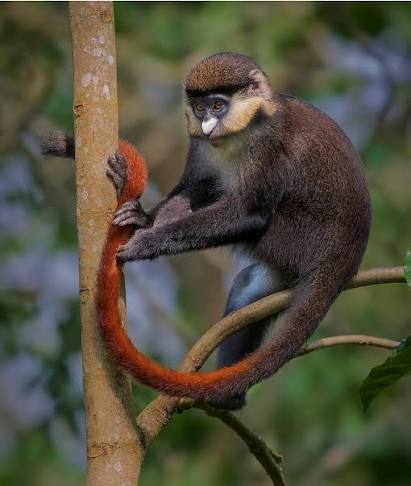
The red-tailed monkey (Cercopithecus ascanius) is one of the most distinctive forest monkeys found in Uganda and across parts of eastern and central Africa. Also known as the red-tailed guenon, this agile Old World monkey gets its name from the reddish or orange coloration that can be visible around the underside of its tail.

But its tail isn’t the only feature that makes this primate interesting. Red-tailed monkeys have expressive faces, complex social relationships, excellent climbing abilities and a remarkably varied diet. They spend much of their lives in forest environments, moving through the canopy in search of fruits, leaves and other foods.

For visitors exploring Uganda’s forests, seeing a red-tailed monkey can be an exciting addition to a chimpanzee or general primate experience. They are not always as easy to spot as larger animals because their small bodies and quick movements allow them to disappear into dense vegetation.

Uganda is particularly important for travelers interested in red-tailed monkeys because the country’s extensive forests support an impressive variety of primates.

From Kibale National Park to other forested landscapes, the red-tailed monkey is part of the diverse ecosystem that makes Uganda one of Africa’s outstanding destinations for primate experiences.

Quick Facts About the Red-Tailed Monkey

Common nameRed-tailed monkey
Other nameRed-tailed guenon
Scientific nameCercopithecus ascanius
Animal groupOld World monkey
FamilyCercopithecidae
DietOmnivorous, with a strong preference for fruits and plant foods
HabitatTropical forest, woodland and forest edges
DistributionEastern and central Africa
Social structureSocial groups
Main foodsFruits, leaves, seeds, flowers and insects
Conservation statusLeast Concern
Main threatsHabitat loss, forest fragmentation and hunting in some areas

What Does a Red-Tailed Monkey Look Like?

The red-tailed monkey is a relatively small and slender primate.

Its body is generally covered in dark or grayish fur, while the face has distinctive pale markings that can make the species easier to identify.

The name comes from the reddish or orange coloration associated with the tail, particularly toward the underside or tip.

Another striking characteristic is the monkey’s expressive face.

Depending on the individual and population, facial markings can include pale areas around the mouth, cheeks and nose.

The tail is long and plays an important role in balance as the animal moves through branches.

Unlike a gorilla or baboon, which has a much heavier body, the red-tailed monkey is built for agile movement through the forest canopy.

When moving quickly between branches, its lightweight body and long limbs allow it to navigate complicated vegetation with impressive speed.

Why Is It Called a Red-Tailed Monkey?

The name is relatively straightforward.

The species has reddish or orange coloration associated with its tail, making it one of the features used to distinguish it from several other forest monkeys.

You may also hear it called a red-tailed guenon.

The term “guenon” refers to a group of African monkeys that includes many species with distinctive facial patterns and adaptations for forest life.

Where Do Red-Tailed Monkeys Live?

Red-tailed monkeys are widely distributed across parts of eastern and central Africa.

They are strongly associated with forested habitats, including:

  • Tropical rainforests
  • Evergreen forests
  • Woodland
  • Forest edges
  • Secondary forests
  • Riverine vegetation

They are particularly well adapted to environments where trees provide food, shelter and escape routes.

In Uganda, they can be encountered in several forested regions.

One of the most important areas for Uganda’s primate tourism is , which is famous for its chimpanzees and exceptionally high primate diversity.

Red-tailed monkeys can also occur in other suitable forest habitats around the country.

Red-Tailed Monkeys in Uganda

Uganda is sometimes described as one of Africa’s best destinations for primate experiences because of the number and variety of species found within the country.

The red-tailed monkey contributes to this diversity.

Kibale National Park

Kibale is perhaps the most important destination to mention when discussing Uganda’s forest primates.

The park contains a rich community of monkeys and other primates, and visitors exploring its forests may encounter red-tailed monkeys moving through the canopy.

Chimpanzee trekking remains the park’s major attraction, but the wider primate diversity is an important part of the experience.

Queen Elizabeth National Park

Queen Elizabeth’s diverse ecosystems include forested areas where several primate species can be encountered.

Red-tailed monkeys may occur in suitable habitats within and around the park.

Bwindi Impenetrable National Park

Bwindi is internationally famous for mountain gorillas, but its forests contain a much broader range of wildlife.

Red-tailed monkeys can form part of the park’s wider primate diversity.

What Do Red-Tailed Monkeys Eat?

Red-tailed monkeys have a flexible diet.

Fruits are an important part of their diet, particularly when seasonal fruiting trees are producing abundant food.

They can also consume:

  • Leaves
  • Seeds
  • Flowers
  • Buds
  • Young shoots
  • Insects
  • Other small animal foods

This flexibility allows them to adapt to seasonal changes in the forest.

When fruit becomes less abundant, they can switch to other food sources.

Their feeding behavior also has ecological importance.

By consuming fruit and moving through the forest, red-tailed monkeys can help transport seeds from one location to another.

This makes them part of the forest’s natural regeneration processes.

How Do Red-Tailed Monkeys Move?

Red-tailed monkeys are highly agile.

They spend much of their time moving through trees and can leap between branches when traveling or escaping danger.

Their long tail helps provide balance.

They may also descend toward lower vegetation or the ground when necessary.

Their agility is particularly useful in dense forests where movement requires constant adjustments.

For a visitor, this can make them both fascinating and difficult to photograph.

One moment a monkey may be sitting quietly in the canopy.

The next, it can disappear behind leaves and emerge several branches away.

Red-Tailed Monkey Social Life

Red-tailed monkeys are social animals.

They live in groups and maintain relationships through grooming, vocal communication, play and physical interaction.

Social life is important because group living provides several advantages.

Individuals can cooperate in detecting predators and maintaining contact while moving through dense forest.

Young animals also benefit from growing up around other members of the group.

They have opportunities to observe adults and learn important social behaviors.

Communication

Communication is a major part of red-tailed monkey life.

They use:

  • Vocal calls
  • Facial expressions
  • Body movements
  • Physical contact
  • Grooming

Their calls can help individuals maintain contact when visibility is poor.

This is especially useful in tropical forests.

Dense vegetation can make it difficult for a group member to see another animal even when they are relatively close.

Vocal communication helps maintain cohesion.

Alarm calls can also alert the group to potential predators.

Predators of Red-Tailed Monkeys

Despite their agility, red-tailed monkeys face several threats from predators.

Potential predators include:

  • Leopards
  • Large snakes
  • Birds of prey
  • Other forest predators

Young monkeys are particularly vulnerable.

The ability to detect danger early is therefore extremely important.

When a predator is detected, members of the group can respond rapidly.

Some individuals may climb higher into the canopy, while others move away from the danger.

Their agility and knowledge of the forest provide important defensive advantages.

Red-Tailed Monkeys and Other Primates

Uganda’s forests contain several monkey species, so visitors may encounter different primates during the same trip.

Red-tailed monkeys can sometimes be confused with other small forest monkeys because many species share similar body sizes and colors.

Experienced guides rely on features such as:

  • Facial markings
  • Tail coloration
  • Body shape
  • Calls
  • Habitat
  • Movement patterns

This is another reason why traveling with a knowledgeable guide can greatly improve a primate-viewing experience.

Red-Tailed Monkey vs Blue Monkey

Both species are forest-dwelling monkeys and can occur in similar environments.

However, they have different appearances.

Blue monkeys tend to have a more grayish or bluish coloration and distinctive facial characteristics.

Red-tailed monkeys have more noticeable reddish or orange coloration around the tail and their own characteristic facial markings.

Both are agile canopy dwellers, and both contribute to Uganda’s impressive primate diversity.

Internal link: Blue Monkey

Red-Tailed Monkey vs Vervet Monkey

Vervet monkeys are generally more associated with open woodland and savannah environments, although they can also use forest edges.

Red-tailed monkeys are more strongly associated with forest habitats.

Vervets are therefore more likely to be encountered during conventional savannah game drives, while red-tailed monkeys are particularly relevant to forest and primate experiences.

Red-Tailed Monkey vs Olive Baboon

The difference between a red-tailed monkey and an olive baboon is obvious in size and lifestyle.

Olive baboons are considerably larger, have powerful bodies and spend substantial amounts of time on the ground.

Red-tailed monkeys are much smaller and more adapted to moving through forest vegetation.

Baboons can be seen crossing open safari roads, while red-tailed monkeys may be high in the canopy and partly hidden by leaves.

Reproduction and Young

Female red-tailed monkeys invest significant care in raising their offspring.

Newborns depend heavily on their mothers during the early stages of life.

The infant may cling to the mother as she moves through the forest.

As it grows, it gradually becomes more independent and begins interacting with other members of the group.

Young monkeys often engage in play.

They chase one another, climb, jump and experiment with social interactions.

These activities help develop coordination and teach youngsters how to behave within their social group.

The Importance of the Mother-Infant Bond

The relationship between a mother and her infant is one of the most important relationships in a young monkey’s life.

The mother provides:

  • Protection
  • Transportation
  • Food access
  • Social support
  • Learning opportunities

For safari photographers, mother-and-infant interactions are among the most rewarding scenes to capture.

However, visitors should avoid making noises or attempting to attract the animals’ attention.

Natural behavior is always more valuable than a staged photograph.

What Threatens Red-Tailed Monkeys?

Although the red-tailed monkey is classified as Least Concern, local populations can still experience significant threats.

Habitat destruction

Deforestation can remove important feeding and sleeping areas.

Forest fragmentation

When continuous forest is divided into isolated patches, monkeys may struggle to move safely between habitats.

Hunting

Some populations experience hunting pressure.

Human-wildlife conflict

As forests become smaller, wildlife can come into closer contact with surrounding communities.

Protecting natural forests is therefore essential.

Conservation in Uganda

Uganda’s protected forests play an important role in conserving red-tailed monkeys and many other species.

Kibale National Park is particularly valuable because of its exceptional primate diversity.

Forest conservation also benefits many other animals simultaneously.

Protecting a forest doesn’t just protect one monkey species.

It preserves habitat for chimpanzees, birds, elephants, antelopes, insects, trees and countless other organisms.

This is why primate conservation should always be considered within the larger ecosystem.

Can You See Red-Tailed Monkeys During Chimpanzee Trekking?

Potentially, yes.

Kibale’s forests contain several primate species, so travelers searching for chimpanzees may encounter red-tailed monkeys along the way.

However, it is important to understand that the primary goal of chimpanzee trekking is to locate habituated chimpanzee communities.

Other primates are an added part of the forest experience.

What Is It Like to See a Red-Tailed Monkey in the Wild?

Seeing one in the wild can be very different from seeing a monkey in captivity.

There may be no warning.

You could be walking along a forest trail when your guide suddenly stops and points upward.

You look into the canopy.

A branch moves.

Then a red-tailed monkey appears.

It watches the group for a moment before moving away.

Sometimes the encounter lasts only a few seconds.

Other times, you may have an opportunity to observe a troop feeding or interacting.

That unpredictability makes wild primate encounters so exciting.

Best Time to See Red-Tailed Monkeys

Red-tailed monkeys can be encountered throughout the year in suitable habitats.

Their visibility depends on several factors, including:

  • Weather
  • Food availability
  • Forest density
  • Animal movement
  • Seasonality

For visitors planning a broader Uganda safari, the best travel period should therefore be determined by the complete itinerary rather than this species alone.

If your trip combines chimpanzee trekking, gorilla trekking and wildlife safaris, consider the conditions for all of these experiences.

How Difficult Is It to Spot Them?

Red-tailed monkeys can be more challenging to see than larger primates.

Their relatively small bodies and forest habitat provide excellent camouflage.

They also move quickly.

This makes an experienced guide extremely valuable.

A guide may recognize a call or movement before the visitor even knows that monkeys are nearby.

Learning to listen to the forest can be just as important as scanning the trees.

Photography Tips

Red-tailed monkeys can be excellent photography subjects, but forest conditions can make photography difficult.

A telephoto lens is useful because animals may be high in the canopy.

Fast shutter speeds can help freeze movement.

Look for moments such as:

  • Mother and infant interactions
  • Grooming
  • Feeding
  • Juveniles playing
  • Leaping between branches
  • Group movement

Don’t concentrate entirely on getting a perfect portrait.

Capturing the animal within its forest environment can tell a much stronger story.

Responsible Wildlife Viewing

Visitors should always observe red-tailed monkeys without interfering with their natural behavior.

Never:

  • Feed them
  • Call them toward you
  • Throw food
  • Attempt to touch them
  • Chase them for photographs
  • Throw objects to make them move

Instead, remain quiet and let the animals decide how close they want to come.

This is particularly important for forest primates because repeated disturbance can change their natural behavior.

Interesting Facts About Red-Tailed Monkeys

They are highly agile.
Their bodies are adapted for fast movement through trees.

Their tails help with balance.
This is particularly useful when navigating branches.

They are fruit lovers.
Fruit is an important part of their diet when available.

They contribute to seed dispersal.
Their feeding behavior can help move seeds through the forest.

They are highly social.
Groups maintain complex relationships through grooming and communication.

They are excellent forest survivors.
Their flexible diets help them cope with seasonal changes in food availability.

They can be difficult to spot.
Their small size and forest habitat make them much less obvious than savannah wildlife.

Frequently Asked Questions

What is a red-tailed monkey?

The red-tailed monkey, also called the red-tailed guenon, is a small Old World monkey found in forests across parts of eastern and central Africa.

Why is it called a red-tailed monkey?

The species gets its common name from the reddish or orange coloration associated with its tail.

Where can I see red-tailed monkeys in Uganda?

They can be encountered in suitable forest habitats, including areas such as Kibale National Park, Queen Elizabeth National Park and Bwindi.

What do red-tailed monkeys eat?

They mainly eat fruits and other plant foods, including leaves, seeds, flowers and young shoots, while also consuming insects and other small foods.

Are red-tailed monkeys dangerous?

They generally avoid people, but they are wild animals and should not be approached, touched or fed.

Can I see red-tailed monkeys during chimpanzee trekking?

Yes, they may be encountered during forest trekking, particularly in areas with high primate diversity such as Kibale.

Are red-tailed monkeys endangered?

The species is currently classified as Least Concern, although habitat destruction and hunting can create serious local threats.

What predators hunt red-tailed monkeys?

Leopards, large snakes and birds of prey are among the potential predators.

Are red-tailed monkeys social?

Yes. They live in groups and maintain relationships through grooming, vocal communication and other social behaviors.

Are red-tailed monkeys found outside Uganda?

Yes. Their distribution extends across several countries in eastern and central Africa.

Why Red-Tailed Monkeys Are Worth Looking For on a Uganda Safari

The red-tailed monkey is a perfect example of why Uganda’s wildlife story extends far beyond its most famous animals.

A visitor may arrive in Uganda dreaming of seeing a mountain gorilla or chimpanzee, but the forests offer an entire community of wildlife.

There are monkeys moving through the canopy, birds calling from hidden branches and countless smaller species contributing to the ecosystem.

The red-tailed monkey is part of that story.

Its agility, social behavior and relationship with the forest make it an important species to understand, especially for travelers interested in Uganda’s incredible primate diversity.

And sometimes, the most memorable wildlife encounter isn’t the animal you spent the whole day searching for.

It is the unexpected flash of a red tail disappearing through the canopy.


Get a free quote